
The green development of traditional Chinese medicine resources industry is one of the symbols of high-quality development. With the promotion of the healthy China strategy, the contradiction between the rapid increase of people's demand for natural drugs and the scarcity of traditional Chinese medicine resources has become increasingly prominent. How to realize the most effective utilization of traditional Chinese Medicine resources has become an urgent problem to be solved in the development of traditional Chinese medicine industry. 《Chinese Pharmacopoeia》2015The annual edition contains a total of618Species, common medicinal materials are determined540Species, common medicinal parts14It also stipulates that only one part of the same plant of medicinal materials is used as medicine during processing. If other parts are mixed during processing, it will be regarded as counterfeit medicine, and the remaining parts after processing will be discarded or even burned[1]Therefore, at present, the utilization of traditional Chinese medicine resources in the whole industrial chain is relatively low. According to statistics, the biomass of non medicinal parts produced in the production of medicinal materials in China is as high as1.1×107~1.6×10⁷ t, millions of tons of drug residues are produced in the process of deep processing, which brings great pressure to the ecological environment. However, the comprehensive utilization technology and application practice of waste by-products produced in the production of traditional Chinese medicine in China are still in the primary stage. Therefore, there is an urgent need to explore aThe way of sustainable development for the recycling of by-products of traditional Chinese medicine resources industry.
1 Generation and classification of by-products of traditional Chinese medicine resources industry
1.1 The concept of by-products of traditional Chinese medicine resources industry
The by-products of the traditional Chinese medicine resource industry, also known as the wastes of the traditional Chinese medicine resource industry, refer to the undeveloped and utilized traditional Chinese medicine resource organism waste tissues and organs, unused usable substances, traditional Chinese medicine waste residue, waste water, waste gas, etc. produced in the process of planting, breeding, collecting traditional Chinese medicine resources (including plant, animal and mineral medicinal resources), processing and production of traditional Chinese medicine decoction pieces, preparation of traditional Chinese medicine extracts or production of traditional Chinese medicine formula particles, and the manufacturing of resource products characterized by consumption of traditional Chinese medicine and natural medicinal biological resources[2]。
1.2 The production of by-products of traditional Chinese medicine resources industry
Traditional Chinese medicine resources include traditional Chinese medicine plant resources, traditional Chinese medicine animal resources and traditional Chinese medicine mineral resources. All kinds of by-products may be produced at all stages of the production process of the whole industrial chain, including the waste by-products of traditional Chinese medicine resources in the process of resource cultivation, breeding and mining, primary processing, prefabrication, processing of traditional Chinese medicine decoction pieces and granules, traditional Chinese medicine preparation, and the manufacturing of traditional Chinese medicine health food and other resource products. Specifically, it mainly includes:(1)The medicinal parts produced in the process of cultivation, breeding or mining of Chinese medicinal materials that are not specified in the Chinese Pharmacopoeia, that is, the traditional "non medicinal parts"; For example, the medicinal part of Tripterygium wilfordii is the root xylem after peeling, and its stems, leaves, flowers and fruits become waste by-products in the process of harvesting and processing. However, through research, the chemical constituents and pharmacological activities of the stems, leaves and roots of Tripterygium wilfordii are basically the same, which has great potential for resource utilization[3]。(2)"Leftovers", broken tissues, debris, powder and slag generated during the primary processing of plant drugs, processing of decoction pieces, and mining of mineral resources of traditional Chinese medicine. The(3)The waste residue, waste liquid and waste gas produced in different stages of the production of traditional Chinese medicine resources. For example, in the process of product manufacturing, the extraction or refining process is used to form waste liquid, but because the extraction or refining process is not enough to remove all effective substances, there are still available effective ingredients in the waste by-products of traditional Chinese medicine resources. The(4)The lack of scientific understanding of the multi functional substances of traditional Chinese medicine makes the resources of traditional Chinese medicine in the state of "total extract" and "parts (groups)" during processing and utilization, and the effective components with utilization value or potential utilization value in the resources of traditional Chinese medicine are discarded in the form of waste and by-products of traditional Chinese medicine resources.
1.3 Classification of by-products of traditional Chinese medicine resources industry
Although the by-products of the traditional Chinese medicine resource industry have a wide variety, different forms and different production conditions, from the perspective of resource economics, the by-products of the traditional Chinese medicine resource industry are the carriers of certain substances and energy, and are resources that can produce value or even significant value through certain technological processing.
1.3.1 According to the different states produced in the process of deep processing industrialization of traditional Chinese medicine resources, the by-products of traditional Chinese medicine resources industry can be divided into solid by-products, liquid by-products and gaseous by-products.
(1)Solid by-products: solid by-products such as roots, stems, leaves, flowers, fruits, debris and other non medicinal parts can be produced during the planting, harvesting, breeding and collection of traditional Chinese medicine resources, but can be used as resources. In addition, traditional Chinese medicine resources also produce waste residue, sediment, filter solids and other types of solid by-products during the preparation of extracts. For example, in the process of preparing formula granules from traditional Chinese medicine resources, drug residues will be produced after water extraction. These waste drug residues contain secondary small molecule fat soluble components, macromolecular primary products and other substances that can be used[2]。
(2)Liquid by-products: liquid by-products will be produced during the processing of traditional Chinese medicine resources, such as extraction or refining. At present, separation materials such as macroporous adsorption lipids, polyamides, ion exchange resins, and ultrafiltration materials such as ceramic membranes and organic membranes are often used in the preparation of traditional Chinese medicine products. In this process, elution wastewater will be produced. These wastewater have high organic concentration, high color, large impact load, complex composition and high content of harmful substances[2]。
(3)Gaseous by-products: mixed gas by-products will be produced during the processing and utilization of traditional Chinese medicine resources. In the process of processing, aromatic herbal medicines such as peppermint, Schizonepeta tenuifolia, Perrin and Artemisia annua, which are rich in volatile chemical components, will volatilize or sublimate the small molecule gas mixture such as monoterpene and sesquiterpene, forming gaseous by-products. Rhubarb, sheep feet and other traditional Chinese medicine resources rich in anthraquinones and their decoction pieces will also produce gaseous by-products due to sublimation during the drying process.
1.3.2 If classified according to the type of ingredients contained in the by-products of traditional Chinese medicine resource industry, the by-products of traditional Chinese medicine resource industry can be divided into the following4Class.
(1)Industrial by-products of traditional Chinese medicine resources rich in cellulose: waste plants, stems, leaves, branches, corks, wood cores, etc. produced by traditional Chinese medicine resources in the whole process of planting and processing in the origin, as well as by-products rich in fiber substances such as roots, rhizomes, whole grasses, stems and trees produced by the manufacturing process of traditional Chinese medicine resource products.
(2)Industrial by-products of traditional Chinese medicine resources rich in fat (hydrocarbon): such as almonds, peach kernel, purple perillaSchisandra chinensis, safflower seeds, etc. often produce by-products rich in hydrocarbons, Oils and fats with great potential for reuse in the production of traditional Chinese medicine formula particles by water extraction process or in the process of deep processing and manufacturing.
(3)Industrial by-products of traditional Chinese medicine resources rich in biological macromolecules: some traditional Chinese medicine plants will produce rhizomes, fruits, seeds, animal bodies or tissues rich in polysaccharides, proteins and other macromolecules during harvesting or processing in the production area. Such as white peony, yam, lotus rootOphiopogon japonicus, ginkgoZedoary turmericIn the process of harvesting or processing, it will produce by-products with reuse potential, such as cork, outer skin layer and powder chips.
(4)Industrial by-products of traditional Chinese medicine resources rich in bioactive small molecular substances: for example, the water extract and alcohol precipitate of Salvia miltiorrhiza contains rich small molecular substances——Stachyose, stachyose is an important pharmaceutical raw material, which can promote intestinal function, and can be made into drugs, health food, food excipients and fillers.
2 Theoretical basis of utilization of by-products of traditional Chinese medicine resources industry
The pollution and ecological damage caused by the utilization of resources, including traditional Chinese medicine resources, have attracted the attention of scholars, and some scholars have put forward relevant theories to analyze it and put forward solutions. One of the most representative is the theory of externality andPigouTax design, circular economy theory and green value innovation theory. The logic to solve the problem is from forcing enterprises to reduce emissions through external constraints and punishment mechanisms to giving enterprises internal drive, promoting them to actively improve the efficiency of resource utilization and reuse, realize value-added and creation, and then voluntarily reduce emissions to achieve Pareto optimization of resource utilization.
2.1 The negative externalities of traditional Chinese medicine resources industry andPigouTax solutions
It is a negative externality problem in economics that the wastes generated in the utilization of traditional Chinese medicine resources are directly discharged without treatment, resulting in environmental pollution and ecological damage. That is, an economic entity (such as a traditional Chinese medicine pharmaceutical enterprise) has caused unexpected losses to other economic entities (such as residents near the enterprise) without compensation, and the balance of marginal cost and marginal income cannot be formed, and some perfect market advantages cannot be presented.20At the beginning of the th century, economistsPigouA simple solution to this problem is to levy a tax so that the tax rate is equal to the marginal external cost. For example, it is levied on the traditional Chinese medicine pharmaceutical enterprises that discharge sewagePigouTax, forcing enterprises to consider all economic costs (including private costs and social costs previously ignored by enterprises), making marginal costs(MC)Equal to marginal income(MR)。PigouTax essentially creates a kind of environmental property right for the state, which enables the polluter to compensate for the losses caused by pollution. However, such measures only encourage enterprises to take the responsibility passively, and do not really take into account the resource and value characteristics of traditional Chinese medicine by-products.
2.2 Social contribution of super circular economy theory to solving negative externalities
20century60American economists in the SK•Polding put forward the concept of circular economy, which provides a new idea for solving the problem of negative externality of pollution and giving consideration to the economic benefits of enterprises and the full utilization of resources. The national development and Reform Commission defines circular economy as "an economic growth model that takes the efficient utilization and recycling of resources as the core, the principle of 'reduction, reuse and recycling', the basic characteristics of low consumption, low emissions and high efficiency, and conforms to the concept of sustainable development." circular economy advocates organizing economic activities into a closed-loop material flow cycle process of "resources → production → consumption → renewable resources", extending the value chain, and achieving the best resource utilization efficiency of optimal production, optimal consumption and minimum waste. It is emphasized that comprehensive utilization of resources should be realized in the production of waste by-products, and various waste resources should be vigorously recovered and recycled in the production of renewable resources. Therefore, circular economy is also a self circular economy with the reuse of "waste" resources as the core. Based on the theory of circular economy, German scholarsManfred EigenThe theory of super circular economy is put forward. The structure of circular economy is divided into basic level cycle (material, energy and information cycle) and innovation level (system opening and development efficiency innovation). The economic cycle is "resources → production → consumption → renewable resources → innovation → new cycle"; And expand the principle of circular economy to the principle of "reduction, recycling, reuse and re innovation"[4]It emphasizes the symbiosis between industrial development and ecological environment, as well as process innovation, management innovation and technological innovation in the process of recycling and reuse[5]The theory of super circular economy provides a higher level of requirements for the high-quality development of the traditional Chinese medicine resource industry, establishes the core concept and development mode of high-quality development, requires innovation in the recycling and reuse of the by-products of the traditional Chinese medicine resource industry, extends the value chain to innovate the utilization of traditional Chinese medicine resources, and cooperates with upstream and downstream enterprises to create the whole industry chain mode. The realization of green value requires the use of new technologies to create green products, innovative management methods to create enterprise social value, and innovative traditional Chinese medicine resource utilization processes to form high-quality products/A highly efficient super circular economic system.
2.3 Green value innovation theory and green value creation of by-products of traditional Chinese medicine resources industry
The green value innovation of the by-products of the traditional Chinese medicine resource industry is a process of using new technologies to realize the resourcefulness of the by-products of the traditional Chinese medicine resource industry. It evaluates and innovates the value of traditional Chinese medicine resources based on the concept of health medicine, and takes people's health as the core to improve the sustainable development ability of the traditional Chinese medicine resource industry. The theory proposes thatTake "reduction, recycling, reuse and re innovation" as the standard to evaluate whether the whole industry has formed a green supply chain system with the best production, the best consumption, the least waste and the best utilization. Evaluate the level of green value innovation of traditional Chinese medicine resource enterprises by using modern science and technology, the green development concept of enterprise management, innovatively reconstruct the management ability of supply chain, and tap the potential utilization value of by-product resources of traditional Chinese medicine resource industry. Traditional Chinese medicine resource enterprises not only pay attention to the full utilization of traditional Chinese medicine resources, but also realize the maximization of green utilization and value-added of traditional Chinese medicine resources. Specifically, advanced scientific methods and appropriate technologies should be used as far as possible to fine separate and process the waste by-products that have not been effectively used in the production of traditional Chinese medicine, so as to make the best use of traditional Chinese medicine resources[6]Through the transformation of by-products of traditional Chinese medicine resources industry to realize value innovation and appreciation, we can judge whether traditional Chinese medicine pharmaceutical enterprises and related enterprises have achieved high-quality development, created green economic benefits, and creatively utilized waste by-products. If the enterprise realizes the transformation and utilization of the by-products of the traditional Chinese medicine resources industry, and reduces the pressure of environmental pollution, it will create the green value of the environment.
3 Analysis on utilization mode of by-products of Chinese traditional medicine resources industry based on theory guidance
3.1 Analysis on traditional treatment methods of by-products in Chinese traditional medicine resources industry
In China, the traditional treatment of by-products of traditional Chinese medicine resources industry is simply discarded or incinerated. However, with the continuous improvement of environmental protection and cleaner production requirements for enterprises, some enterprises have also started to carry out simple rough processing of by-products of traditional Chinese medicine resource industry, and also carry out resource treatment to prepare them into resource products of traditional Chinese medicine.
Traditional treatment methods for by-products of traditional Chinese medicine resource industry mainly include:(1)Without treatment and utilization, most of them are directly discharged into the environment. For the by-products of traditional Chinese medicine resource industry, the traditional treatment methods are centralized stacking, incineration or landfill, or even direct discharge. These treatment methods not only occupy a lot of valuable land resources, but also cause serious pollution to groundwater, air and soil. At the same time, with the continuous improvement of environmental protection requirements, enterprises also need to bear high sewage charges, which increases the operating costs of enterprises. The(2)Preliminary processing and utilization. In recent years, traditional Chinese medicine enterprises have gradually realized the economic value of the by-products of the traditional Chinese medicine resource industry, and began to simply process and reuse the by-products according to the physical characteristics of the by-products of the traditional Chinese medicine resource industry. However, the development and utilization level of the by-products of the traditional Chinese medicine resource industry by most enterprises is relatively primary. The main approach is to carry out primary processing of the by-products of the traditional Chinese medicine resource industry with conventional technologies and processes to produce organic fertilizers, fiberboards, fuels and feed additives.
In recent years, with the continuous expansion of the market demand for traditional Chinese medicine products, the production of traditional Chinese medicine by-products has also increased year by year, and the environmental bearing pressure has further increased. In addition, with the improvement of relevant national cleaner production and environmental protection laws, scholars and enterprises have begun to pay attention to the research and practice of the effective disposal and resource utilization of traditional Chinese medicine by-products. This also produces2A new treatment method for by-products of traditional Chinese medicine:(1)Deep processing. According to the composition and physicochemical properties of the by-products of traditional Chinese medicine resources industry, the effective components with reuse value are extracted, purified and enriched by using modern processes and technical means, so as to obtain high value-added products with stable quality, high content of effective components and high purity. If usedPVDFThe ultrafiltration membrane enriches the volatile oil of cortex Isatidis in the wastewater generated after pharmaceutical production, and the interception rate of essential oil reaches67.5%, and passedGC-FID By comparing the chemical components of the samples before and after the membrane process, it was found that the volatile oil enriched by ultrafiltration was almost the same as the original volatile oil[7]。(2)Comprehensive utilization. This method has changed the traditional practice of only partial or single utilization of resources, followed the principle of "reduction, reuse and recycling" of circular economy, and comprehensively, repeatedly and repeatedly utilized certain resources and waste by-products in different ways and means through the management of the whole production process to form a variety of resourced products and recycled products. For example, mint is extracted according to the medicinal parts specified in the Chinese Pharmacopoeia to make drugs, the remaining residual grass by-products are processed into organic fertilizers, and the by-products formed after oil extraction are extracted with advanced technology to make triterpenoids such as Mongolian glucoside into immune modulators.
In general, the current utilization mode of Chinese traditional medicine by-products is still extensive, which can not meet the current high-quality development requirements of the industry and the construction needs of healthy China. The by-products are far from being utilized as resources, and the industrial system of super circular economy has not been established. The green value of Chinese traditional medicine resources needs to be fully explored. Under the background of China's new economic development, traditional Chinese medicine enterprises must pay attention to the full development and utilization of traditional Chinese medicine resources, and reuse the industrial by-products of traditional Chinese medicine resources through technological and technological innovation, so as to change their external characteristics and physicochemical characteristics, enhance and expand their functions and functions, so as to improve the efficiency of resource development and utilization and realize new value creation.
3.2 Analysis on the utilization model system of by-products of traditional Chinese medicine resources industry
The by-products of traditional Chinese medicine resources industry are mainly composed of effective components that can be reused, such as crude fiber, crude protein, crude fat and a variety of trace elements, including small molecule secondary metabolites generated through a series of biochemical reactions, such as terpenoids, steroids, alkaloids, polyphenols, as well as macromolecular substances such as polysaccharides and proteins, using primary metabolites as starting materials. The physical and chemical characteristics of by-products of different types of traditional Chinese medicine resources industry are different, so it is necessary to select an appropriate recycling mode of by-products of traditional Chinese medicine resources industry in order to realize value innovation and make the best use of traditional Chinese medicine resources, while reducing environmental pollution and ecological damage.
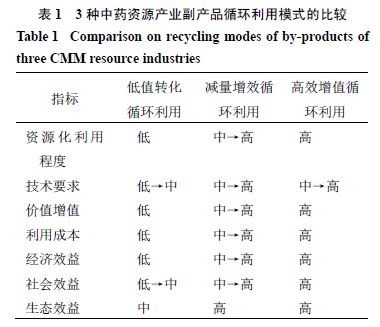
3.2.1 The mode and comparison of recycling utilization of by-products in traditional Chinese medicine resources industry Although the components of by-products of traditional Chinese medicine resource industry are complex and recycling is difficult, as long as the recycling mode is created, the policy mechanism is used to stimulate the development of innovative technology and innovative process, and through the collaborative innovation method and supply chain management method, we can use modern technology to analyze the residual active ingredients, content, pharmacology, pharmaceutical properties and functions of different traditional Chinese medicine by-products, so as to determine their resource potential and utilization value, and then design the recycling mode and method of by-products of traditional Chinese medicine resource industry[5]Transform the current extensive recycling mode of by-products of traditional Chinese medicine resources industry, and establish a gradient comprehensive utilization mode system combining low value conversion recycling, reduction and efficiency increasing recycling and high-efficiency value-added recycling. The advantage of this model system lies in the comprehensive consideration of the physical and chemical properties, resource potential and utilization value of the effective substances contained in the by-products produced during the industrialization of traditional Chinese medicine resources, the targeted implementation of the goal of the recycling of traditional Chinese medicine resources, the selection of recycling mode, and the realization of Pareto optimization of the utilization of traditional Chinese medicine resources.
(1)Low value transformation and recycling mode: according to the characteristics of the by-products of the traditional Chinese medicine resource industry, some of the by-products of the traditional Chinese medicine resource industry have little resource potential, or can not be finely extracted, separated and utilized under the existing scientific and technological conditions, so it is suitable for the low value transformation and recycling mode. That is to say, the by-products of traditional Chinese medicine resource industry will be simply processed to realize feed, fertilizer, matrix, etc., and become renewable resource products. For example, if the by-products of drug residues cannot be effectively extracted and separated, and their fiber content is high, they can be made into fiberboard. In addition, it can be directly compounded with other materials to make various high-quality fertilizers, edible fungus culture media, feed additives, nutritional supplements, or fuel converted into energy after drying. Jujube seed residue contains a large amount of protein, which can be used to prepare animal feed. The fatty substances in jujube seed residue can be made into soap industrial raw materials after preliminary separation.
(2)Circular utilization mode of reduction and efficiency increase: according to the theory of circular economy and super circular economy, the utilization of resources should follow the principle of reduction and reuse. The principle of reducing the utilization of traditional Chinese medicine resources can also be understood as improving the utilization efficiency and reducing the production of by-products. Therefore, the reduction transformation and recycling mode refers to the integration of enzyme transformation technology, microbial transformation technology, fermentation transformation technology and related technologies to improve the utilization efficiency of existing traditional Chinese medicine resources, reduce emissions or convert the recyclable components of the industrial by-products of traditional Chinese medicine resources into resource substances with high utilization value. For example, based on the demand of lignans or effective parts of Schisandra chinensis, seeds are usually used as medicine after the pulp of Schisandra chinensis is soaked and rubbed. The discarded pulp can be separated and broken, and then processed by appropriate enzymatic hydrolysis to form concentrated juice. The juice is homogenized and prepared into Schisandra chinensis fruit juice powder by spray drying. Again, yeslicoriceThe yield of flavonoids could be improved by fermentation and ultrasonic treatment with compound enzyme25%Above.
(3)High efficiency value-added recycling mode: This is a transformation mode with the highest utilization efficiency and the largest value-added of the by-products of the traditional Chinese medicine resource industry. Based on the most advanced scientific research results and technical processes, it uses chemical separation technology to obtain resource chemical components with potential development value or uses modern biotechnology to transform by-products into high value-added resource substances with biological functions, and then forms high value-added products through industrialization, including drugs, medical and health products, cosmetics, flavors and fragrances, chemical products and chemical standards. If the water extract and alcohol precipitate of Salvia miltiorrhiza were added2~5Dissolve in water and acidify topHValue is2~3, centrifuge or filter to clarify the drug solution, decolorize the column chromatography, concentrate the drug solution under reduced pressure, and spray dry to obtain a content of50%~75%Stachys xylose, and then made into high value-added health food.
3See the table for the comparison of recycling modes of by-products of traditional Chinese medicine resources industry1。
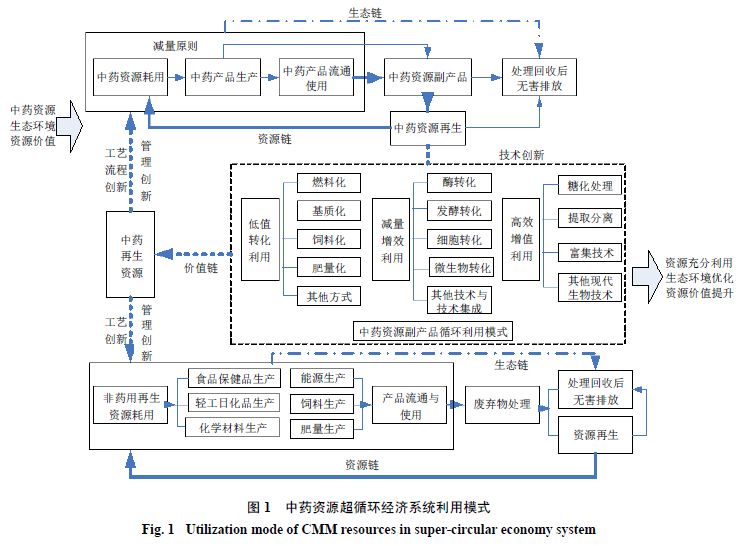
3.2.2 Construction of super circular economy model system for utilization of traditional Chinese medicine resources In order to make the best use of traditional Chinese medicine resources, realize the value innovation of traditional Chinese medicine by-products and enhance the value of the whole industrial chain, it is necessary to build a super circular economy model, that is, "resources → production → consumption → renewable resources → innovation → new cycle". Fully consider the resources of traditional Chinese medicine from the perspective of system theoryEach unit of the utilized resource chain, value chain and ecological chain circulates by itselfInteraction, mutual catalysis, full fusion, and processProcess innovation, technology innovation and management innovation to realize the symbiosis of continuous growth of resources, continuous improvement of ecology and continuous improvement of resource valuedevelop[4]The super circular economic system of resource utilization of traditional Chinese medicine consists of resource chain and priceValue chain and ecological chain together.
The resource chain is the chain of resource flow, which is the basic circulation chain of the super circulation economic system of traditional Chinese medicine resource utilization. The resource chain backbone process is2One is the closed-loop operation of "consumption of traditional Chinese medicine resources → production of traditional Chinese medicine products → circulation and use of traditional Chinese medicine products → industrial by-products of traditional Chinese medicine resources → regeneration of traditional Chinese medicine resources → consumption of traditional Chinese medicine resources"; The other is the closed-loop operation of "consumption of non medicinal resources → production of other products → circulation and use of other products → waste treatment → resource regeneration → consumption of non medicinal resources".
The value chain is the chain of value flow and value-added. It is the driving force of the super circular economic system for the utilization of traditional Chinese medicine resources. Through value creation and value-added, it ensures the good operation of the circular system of traditional Chinese medicine resources. The backbone process of the value chain is similar to the resource chain, but it emphasizes the value creation and value-added process. In addition, different from the resource chain, the value chain emphasizes the innovation behavior in the process of recycling traditional Chinese medicine resources, especially the innovation and value-added in the process of recycling by-products of the traditional Chinese medicine resource industry. Specifically, the recycling of by-products of traditional Chinese medicine resources industry is embedded in the regeneration of traditional Chinese medicine resources3The three models and their specific methods and technological process innovation constitute a multi cycle value-added super cycle system of traditional Chinese medicine resources, such as the recovery, transformation, extraction and utilization of cellulose, amino acids, peptides, proteins, alkaloids, polysaccharides, ketones, triterpenoids and their glycosides, organic acids, secondary small molecules and other resource substances.
Ecological chain is an important goal of the super circular economic system for the utilization of traditional Chinese medicine resources. It is an ecological chain connecting the consumption of traditional Chinese medicine resources, the production of traditional Chinese medicine products, the circulation and use of traditional Chinese medicine products, and the treatment, recovery and emission of the by-products of the traditional Chinese medicine resources industry that can not be recycled or that can not be reused after the by-products are recycled. For example, traditional Chinese medicine resources are planted organically; In the production of traditional Chinese medicine products, enterprises should implement green and clean production and energy-saving measures. The harmless treatment of the non reusable part of the by-products of the traditional Chinese medicine resource industry and its associated material circulation, energy flow, information transmission and capital utilization should be included in the ecological chain of the super cycle system of traditional Chinese medicine resource utilization. The good operation of the ecological chain of traditional Chinese medicine resources can effectively improve and optimize the ecological environment and create green economic value. See the figure for the utilization mode of super circular economy system of traditional Chinese medicine resources1。
4 Strategies for high quality development of traditional Chinese medicine resources industry
4.1 The government plans the construction of healthy cities in the region as a whole、Construction of beautiful countryside and high-quality development goal of traditional Chinese medicine resource industry
With regional development as the center, the government plays a leading role in the construction of a healthy China, and plans the high-quality development policy of coordinating the construction of healthy cities and beautiful villages in the region with the traditional Chinese medicine resource industry. The development of traditional Chinese medicine industry and the recycling of its by-products must be closely related to the long-term development goal of the government. The government must formulate a scientific and meticulous development plan for overall arrangement, ensure the stability of planning and development with policies, and give stable expectations to industries and enterprises. The government requires enterprises to innovate with high-quality development, encourages enterprises to innovate technology and process, efficiently reuse waste traditional Chinese medicine resources, and establish a super recycling system. We can choose the appropriate recycling mode of by-products of the traditional Chinese medicine resource industry in the region, formulate a detailed development plan for the recycling of by-products of the traditional Chinese medicine resource industry, formulate short-term and long-term goals and action guidelines, consciously create conditions for the construction of a super circular economic system for the utilization of traditional Chinese medicine resources in the region, and make corresponding layout. From the system for the local traditional Chinese medicine industry and enterprises to create a good circular economy atmosphere of traditional Chinese medicine resources.
4.2 Encourage relevant enterprises to carry out“Industry University Research Institute”cooperation
In order to realize the recycling and recycling of the by-products of the traditional Chinese medicine resource industry, we must have a strong technological innovation ability. However, at present, the research on the utilization of the by-products of the traditional Chinese medicine resource industry in China is still insufficient, and we need to build a "government-enterprise-society-University research institutions "is a scientific and technological innovation system for the recycling of by-products of traditional Chinese medicine resources industry. The government uses policies and mechanisms to encourage open innovation of enterprises, fully carry out industry university research cooperation, increase collaborative technology development and innovation, establish a special fund for the resource utilization of by-products of the traditional Chinese medicine resource industry, determine the cost of recycling and resource utilization of by-products of the traditional Chinese medicine resource industry in the form of projects, and specify the annual increase of project funds. The fund is mainly used for basic research and common technology research of traditional Chinese medicine resources; Enterprises mainly increase the investment in applied technological innovation and improvement of the recycling of by-products of traditional Chinese medicine resources industry; The government encourages and guides social capital to enter this field through policies; At present, many places have established "industry university research" cooperation platforms. Universities, scientific research institutes and other research institutions can encourage relevant researchers to rely on this platform to understand the demand information and research progress of by-products of the traditional Chinese medicine resource industry, carry out targeted research and scientific and technological research, and truly play their role in serving the society.
4.3 Cultivate and develop regional industrial clusters based on the super circular economy model of traditional Chinese medicine resource utilization
According to the super circular economic model of traditional Chinese medicine resource utilization, the government promotes enterprises to form an industrial system of resource chain, ecological chain and value chain. The interests of each unit are closely linked and operate well, effectively promoting resource utilization, ecological optimization and value-added. This is also the future development direction of traditional Chinese medicine resources industry. It is suggested that regions with conditions and industrial base should actively cultivate and develop vertically integrated regional traditional Chinese medicine industry clusters, and the cluster construction should be scientifically planned and reasonably located. In addition to the traditional Chinese medicine pharmaceutical enterprises, according to the composition of the resource chain, value chain and ecological chain of the traditional Chinese medicine industry, combined with the characteristics and physical and chemical properties of the traditional Chinese medicine resources and their by-products used by the local traditional Chinese medicine pharmaceutical enterprises, relevant enterprises can be attracted to enter the cluster to form a super circular economic system of traditional Chinese medicine resources. If Schisandra chinensis is the main raw material used in the production of local traditional Chinese medicine pharmaceutical enterprises, it can be considered to attract food and health care product manufacturers, feed manufacturers, beverage manufacturers, traditional Chinese medicine planting enterprises and pollutant treatment enterprises to establish close ties with them and form a resource chain, ecological chain and value chain. In addition, the government also needs to establish or guide enterprises through policies to establish a public service platform to meet the needs of clustered enterprises in R & D, small-scale test, pilot test, intellectual property services, logistics services, etc., truly build the traditional Chinese medicine industry cluster into a super circular economic system with self-organization and self catalysis, and create a good regional ecological environment while realizing the full utilization and value-added of the industrial by-products of traditional Chinese medicine resources.
4.4 Innovative health and green products,Build an international enterprise brand for the recycling of traditional Chinese medicine resources.
Industrial green development is the trend of international economic development and the hidden barrier of international trade. Traditional Chinese medicine pharmaceutical enterprises in the new era must establish the concept of circular economy,Enterprises need to attract and cultivate high-quality and excellent R & D and management talents in the recycling of traditional Chinese medicine resources, improve the operation and management level of enterprises based on the concept of circular economy, and use modern technical means to create international healthy green products, turn traditional Chinese medicine by-products into resource green products, so as to form the image of a socially responsible enterprise and create an international brand. Develop new technologies, use appropriate marketing models, reduce transaction costs, actively fulfill corporate social responsibilities, continuously improve the popularity and reputation of enterprises, accumulate social capital, and realize the value-added of resource management[8]At the same time, through policy guidance, regional leading enterprises are encouraged to give full play to the demonstration and diffusion effects, establish innovative organizational forms such as win-win cooperation or strategic alliances with other traditional Chinese medicine enterprises and enterprises in related industries in the region, such as feed processing enterprises and health care product manufacturers, fully tap the potential of the utilization of by-product resources in the traditional Chinese medicine resource industry, and realize the value-added of traditional Chinese medicine resources.
4.5 Establishing a trans regional super circular economy system of traditional Chinese medicine resources
After the establishment and operation of the regional recycling system of by-products of traditional Chinese medicine resources industry, a cross regional recycling system of traditional Chinese medicine resources can be formed through cross regional cooperation, such as the establishment of a super recycling economic system of traditional Chinese medicine resources in the Yangtze River Delta. The regional Chinese medicine industry clusters or enterprises in the system can realize division of labor and cooperation through information sharing, talent flow and material circulation, effectively connect and extend the resource chain, value chain and ecological chain, carry out collaborative innovation activities, form a cross regional Chinese medicine resource super cycle system with hierarchical, specialized and collaborative symbiosis development, and realize the value realization and appreciation of the industrial by-products of Chinese medicine resources and the improvement and optimization of the regional ecological environment during the industrialization of Chinese medicine resources.
5 epilogue
High quality development to realize the recycling of by-products of traditional Chinese medicine resources industry is the only way to solve the negative externality of traditional Chinese medicine production and realize the value innovation of traditional Chinese medicine resources. With the promotion of the construction of a healthy China, people's awareness of environmental protection is increasing, and the society's requirements for the utilization of traditional Chinese medicine resources are increasing. Building a super circular economic system and effectively using the waste resources in the production of traditional Chinese medicine resources is a great plan to benefit the country and the people. Traditional Chinese medicine enterprises are bound to innovate technologies and develop healthy green products by using various appropriate technologies. They are bound to innovate the great health industrial system with Chinese characteristics and promote the benign and sustainable development of the by-products of the traditional Chinese medicine resources industry in China.
References (omitted)
To Source: Li Jie, shenjunlong, duanjinlin Study on the recycling mode of by-products of traditional Chinese medicine resources industry [j]. Chinese herbal medicine, 2019, 50 (1): 1-7
Note: the company Can be used for related production Provided by enterpriseSolutions for the recycling of by-products of traditional Chinese medicine resources industry.