
Abstract: in recent years, the number of new Chinese medicine drugs approved for listing is small, which has become a bottleneck restricting the development of Chinese medicine industry. In view of the above situation, the State Drug Administration has issued a series of regulations and technical requirements. Under the situation of new laws and regulations, this paper deeply analyzes the R & D strategy of innovative traditional Chinese medicine under the guidance of new registration classification, and analyzes and discusses the key technical issues in the R & D process.
Traditional Chinese medicine embodies the broad and profound wisdom of the Chinese nation, and plays a unique and indispensable role in promoting people's health and preventing major diseases. The Party Central Committee and the State Council attach great importance to the work of traditional Chinese medicine, and have raised the inheritance, innovation and development of traditional Chinese medicine as a national strategy. .
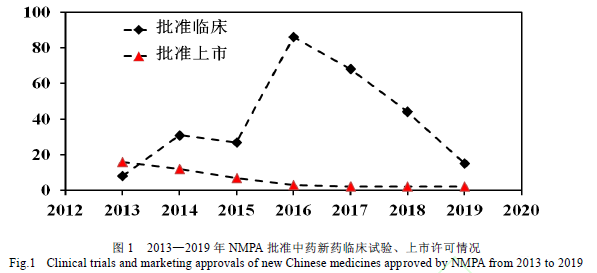
As early as 2017, the general office of the CPC Central Committee and the general office of the State Council issued the "opinions on deepening the reform of the review and approval system and encouraging the innovation of drugs and medical devices", which clearly stated that it was necessary to establish and improve the registration management system and technical evaluation system in line with the characteristics of traditional Chinese medicine [1]. At the same time, the "opinions of the CPC Central Committee and the State Council on promoting the inheritance, innovation and development of traditional Chinese medicine" issued in 2019 also pointed out that it should "speed up the construction of the evidence system for the registration and evaluation of traditional Chinese medicine based on the combination of traditional Chinese medicine theory, human experience and clinical trials, optimize the technical requirements for the evaluation of new traditional Chinese medicine with human experience based on ancient classic famous prescriptions, famous old traditional Chinese medicine prescriptions, preparations of medical institutions, and speed up the approval of new traditional Chinese medicine" [2]. .
At the expert and scholar symposium held in June 2020, General Secretary Xi Jinping pointed out that in view of the development of traditional Chinese medicine, we should "strengthen the combing and mining of the essence of classical medical books, reform and improve the review and approval mechanism of traditional Chinese medicine, and promote the research and development of new Chinese medicine and industrial development" [4]. For the above-mentioned reform and development problems of traditional Chinese medicine, in order to better solve the current difficulties such as the lack of motivation for the research and development of new traditional Chinese medicine, and further implement the decisions and arrangements of the Party Central Committee and the State Council, the State Administration of market supervision and the State Drug Administration (nmpa) And other relevant departments have responded positively, and have issued new measures for the administration of drug registration [5], implementation opinions of the State Food and Drug Administration on promoting the inheritance, innovation and development of traditional Chinese medicine [6], special provisions on the administration of registration of traditional Chinese medicine (Draft for comments) [7], methods for the classification of traditional Chinese medicine registration and requirements for application materials [8], technical guidelines for the preparation of theoretical application materials of traditional Chinese medicine for new Chinese medicine and compound preparations [9], technical guidelines for pharmaceutical research at all stages of new Chinese Medicine Research (Trial) [10], technical guidelines for the quality control research of new Chinese medicine (Trial) [11] A series of regulations and technical guidelines, such as the guiding principles for the processing research technology of new medicinal pieces of traditional Chinese medicine (Trial) [11], the guiding principles for the production process research of traditional Chinese medicine compound preparations (Trial) [12], and the guiding principles for the research technology of the quality standards of new traditional Chinese medicine (Trial) [11], can be seen that at the national level, the problems existing in the review of the original traditional Chinese medicine have been found, and the corresponding solutions have been actively introduced to reform the review and approval of traditional Chinese medicine, aiming to improve the contents of all links in the whole life cycle of the registration management of traditional Chinese medicine, encourage the research and development and innovation of new traditional Chinese medicine, promote the high-quality development of traditional Chinese medicine industrialization, and better protect.
1
Changes in registration classification of traditional Chinese Medicine
2007There are nine categories of traditional Chinese medicine registration in the version of the measures for the administration of drug registration. The 2020 version of the measures for the administration of drug registration has been changed to four categories, which are innovative traditional Chinese medicine, improved traditional Chinese medicine, traditional Chinese medicine compound preparations of ancient classic famous prescriptions and drugs with the same name [5]. The first three categories belong to the category of new traditional Chinese medicine (Figure 2).
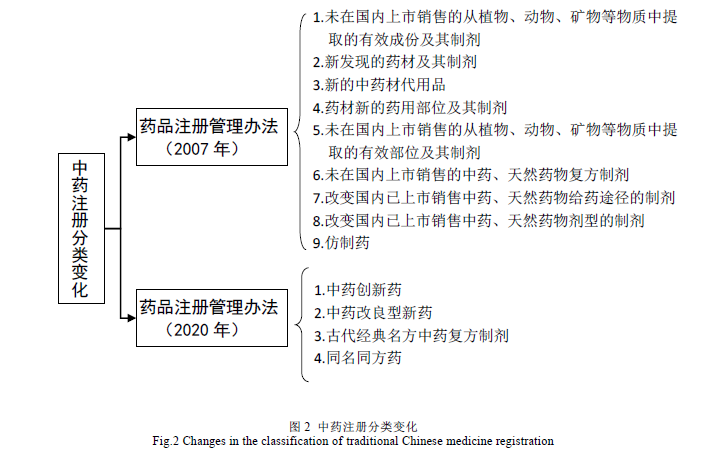
According to the new registration classification of traditional Chinese medicine, innovative traditional Chinese medicine refers to new prescription preparations of traditional Chinese medicine that are not included in the national drug standards, drug registration standards, and the catalogue of ancient classic famous prescriptions issued by the national Department of traditional Chinese medicine, have clinical value, and are not listed abroad [8]. Generally, it includes the following situations: category 1.1 "traditional Chinese medicine compound preparation" refers to the preparation composed of multi flavor decoction pieces, extracts, etc. under the guidance of traditional Chinese medicine theory; Category 1.2 "extracts and preparations obtained from single plants, animals, minerals and other substances"; Category 1.3 "new medicinal materials and preparations", that is, medicinal materials and preparations that are not included in the national drug standards, drug registration standards, and provincial, autonomous region, and Municipal Drug Standards, as well as new medicinal parts and preparations of original animals and plants with the above-mentioned standard medicinal materials [8]. .
Traditional Chinese medicine improved new drugs refer to the preparations that change the administration route and dosage form of the listed traditional Chinese medicine and have clinical application advantages and characteristics, or add functional indications, etc. [8], which are divided into 4 categories, including 2.1 "preparations that change the administration route of the listed traditional Chinese medicine", 2.2 "preparations that change the dosage form of the listed traditional Chinese medicine" [8]. In addition, the new registration classification of traditional Chinese medicine adds 2.3 categories of "traditional Chinese medicine increases functions and indications" and 2.4 categories of "changes in the production process or excipients of listed traditional Chinese medicine cause significant changes in the basis of medicinal substances or drug absorption and utilization" [8], which aims to encourage applicants to study "old drugs and new uses" based on the new clinical needs and to optimize the production process of listed traditional Chinese medicine [13].
Traditional Chinese medicine compound preparations of ancient classical famous prescriptions refer to the prescriptions recorded in ancient Chinese medicine classics that comply with the provisions of the Chinese medicine law of the People'sRepublic ofChina, are still widely used, have exact curative effects, and have obvious characteristics and advantages [8]. According to the law of inheritance and development of traditional Chinese medicine and the characteristics of clinical application of traditional Chinese medicine, the new registration classification of traditional Chinese medicine subdivides three categories of "traditional Chinese medicine compound preparations of ancient classic famous Prescriptions" into two situations, namely, category 3.1 is "traditional Chinese medicine compound preparations managed according to the ancient classic famous prescription catalog", and category 3.2 is "other traditional Chinese medicine compound preparations derived from ancient classic famous Prescriptions", including ancient classic famous prescription traditional Chinese medicine compound preparations not managed according to the ancient classic famous prescription catalog and traditional Chinese medicine compound preparations based on the addition and subtraction of ancient classic famous prescriptions [13].
With the same name and the same prescription, the original registered classification of 9 types of generic drugs has been changed to the same name and the same prescription, but it cannot be simply equivalent to the concept of the original generic drugs. On the basis of the same general name, prescription, dosage form, function, main indications, usage and daily consumption of the same prescription drugs as the listed traditional Chinese medicine, the safety, effectiveness and quality controllability of the same prescription drugs are not lower than those of the listed varieties [8]. ; We should adhere to the clinical value orientation and encourage the innovative development of traditional Chinese medicine; Strengthening the sorting and excavation of the essence of classical medical books to promote the inheritance and development of traditional Chinese medicine; Improve the whole life cycle management and encourage the secondary development of traditional Chinese medicine [13]. These contents reflect the change of nmpa's guiding ideology for the registration and management of new Chinese medicine and provide guidance for the new development of new Chinese medicine research and development.
2
Research and development strategy of innovative traditional Chinese medicine based on new regulations
2.1 R & D concept
The common feature of traditional Chinese medicine and chemical medicine is that they are both clinical value oriented, but the difference is that traditional Chinese medicine has rich historical experience in human use. These valuable human experience contains important effectiveness and safety information of traditional Chinese medicine. Therefore, the biggest difference between the research and development process of traditional Chinese medicine and chemical drugs is that the research and development of new Chinese medicine is a "clinical laboratory clinical" process. It is precisely for this reason that in recent years, nmpa has continuously strengthened the concept of "clinical value oriented and emphasis on human use history" in the evaluation of new Chinese medicine, and the "characteristics" in the establishment of the "evaluation and approval system with characteristics of traditional Chinese medicine" are concentrated on respecting the human use history of traditional Chinese medicine. ? How to embody the importance of human history? How to establish a new research and development mode of traditional Chinese medicine with the characteristics of traditional Chinese medicine? The key to solve these problems is to implement the R & D concept of "taking clinical value as the guidance and paying attention to the history of human use" in all links of R & D, and according to the unique law of new drug research and development of traditional Chinese medicine, explore a set of new drug research and development technology system with traditional Chinese medicine characteristics, so as to effectively shorten the R & D cycle, reduce the R & D risk, and ensure the development of more effective, safe and quality controllable new Chinese medicine [14].
2.2 key encouraging directions
At present, the state promotes the inheritance, innovation and development of traditional Chinese medicine. By adjusting the registration classification of traditional Chinese medicine, the traditional Chinese medicine compound preparation is adjusted from the previous six categories of new drugs to the category of innovative drugs, indicating that category 1.1 "traditional Chinese medicine compound preparation" is the research direction of traditional Chinese medicine innovative drugs. The special provisions on the registration and administration of traditional Chinese medicine (Draft for comments) also clearly points out that: innovative drug prescriptions are derived from the experienced prescriptions of clinical experts of traditional Chinese medicine with rich clinical experience, such as classic famous prescriptions, national medical masters or famous old traditional Chinese medicine, and the extraction process is only water extraction, which can simplify the process research and exempt the non clinical effectiveness research [7]; The development of new drugs of traditional Chinese medicine based on the preparations of medical institutions of traditional Chinese medicine, in which the human experience of the preparations of medical institutions of traditional Chinese medicine has a certain supporting effect on the safety and effectiveness of new drugs of traditional Chinese medicine, such as the prescription composition, extraction process, dosage form, packaging, etc. are consistent with the preparations of the medical institutions, the process and stability research can be exempted, and phase I and II clinical trials can be exempted, and only phase III clinical trials can be carried out [7].
2.3 process research
The goal of process research is the effectiveness and safety of clinical application, and we must respect the history of human use. In the past, there were two main problems in the research of the technological route of new drugs of traditional Chinese medicine. One problem is the "ingredient only theory". In the absence of in-depth research on the rationality of the process route of traditional Chinese medicine with existing human experience, and in the case of unclear effective ingredients, unclear mechanism of action, and unclear correlation between index ingredients and drug safety and effectiveness, the full extraction of index ingredients is blindly taken as the research goal of the process of traditional Chinese medicine compound preparation. For example, the prescription of Zhixue Capsule, a traditional Chinese medicine, is derived from clinical experience. It is composed of Sophora flavescens and cortex dictamni. The traditional method of use is the decoction of the whole prescription. However, in the study of modern technology, researchers only take the full extraction of dictamnine and other components as the research index, and use 85% ethanol to reflux the whole prescription. As a result, after it is listed as a new Chinese medicine, there have been reports of adverse reactions that cause liver injury [15]. This situation has attracted the attention of the research team. In order to explore the influence of process factors on the safety of the preparation, the team carried out relevant research. By comparing the effects of the water extract and alcohol extract of Zhixue Capsule prescription on the liver toxicity of rats, it was found that the liver of rats in the alcohol extract group of the whole formula exhibited obvious hepatic vesicle type steatosis around the hepatic lobule, and the degree of steatosis increased with the increase of ethanol content in the extraction solvent, while the water extract group of the whole formula had no obvious liver toxicity [16]. Another problem is "blind purification". Without full understanding of the effective ingredients contained in traditional Chinese medicine compound preparations, in order to achieve the purpose of making small dosage forms with drug loading such as tablets, capsules, drop pills, etc., purification processes such as repeated alcohol precipitation and macroporous resin adsorption are used to blindly reduce the dosage, which eventually leads to an "effective prescription" being made into an "invalid preparation".
2.4 quality control system
The whole process quality control system of traditional Chinese medicine is run through all aspects of the research and development of new Chinese medicine, and reflects the core connotation of quality delivery. The selected control indicators should be selected according to the prescription composition, preparation process, physicochemical properties of medicinal substances and the characteristics and stability of the preparation of new Chinese medicine [11], so as to establish the whole process quality control system of source control, process control and end-point control, and ensure the safety, effectiveness and quality controllability of new Chinese medicine products [17].
. Source control refers to the control of various key links [14] that affect the quality of traditional Chinese medicine, such as the origin, origin, wild resources, harvesting, processing, processing, storage, etc., selecting indicators that can represent the core quality and are related to the key quality attributes of the preparation, combining the characteristics of traditional Chinese medicine and the needs of the research and design of new traditional Chinese medicine, forming an index system for quality evaluation, and combining the index evaluation results to determine the reasonable quality requirements.
Process control: in the process of research and development of new drugs of traditional Chinese medicine, it is necessary to strengthen the systematic research and control of the quality of medicinal materials / decoction pieces, intermediates, preparations, excipients, packaging materials / containers (which are in direct contact with drugs), pay attention to the dynamic changes of quality that may occur in the production process [11], and establish a standard system for the control requirements of the process content in combination with the formulated production operation procedures and standards.
Endpoint control: the research on the quality standard of finished products of new Chinese medicine should be carried out according to the following principles:
① Pertinence, according to the characteristics of the specific traditional Chinese medicine studied, the indicators that can fully reflect the quality of traditional Chinese medicine preparations and are related to the safety and effectiveness of drugs should be selected for quality control research [6];
② Relevance. Quantitative detection or quality monitoring of the delivery process of medicinal substances from decoction pieces / extracts, intermediates to preparations is the characteristic of quality control of traditional Chinese medicine preparations [11,18]. The quality standards of these traditional Chinese medicine decoction pieces / extracts, intermediates, preparations, etc. constitute the core of the quality standard system of traditional Chinese medicine preparations. Only a perfect quality standard system can ensure the traceability of drug quality, which also reflects the relationship between the quality standards of traditional Chinese medicine preparations and process design, quality research and stability research [11,18];
③ Stage by stage, the research on quality standards of new Chinese medicine is a process of continuous improvement with the improvement of product cognition and the continuous progress of science and technology. When applying for clinical trials, it is necessary to clarify the origin, medicinal parts and processing methods of herbal pieces. . When applying for marketing license, it is necessary to fix the base source, origin, medicinal parts, harvest date, processing method and processing parameters of medicinal materials [10,18], and improve the quality standards of medicinal materials and decoction pieces in combination with clinical trials and preparation requirements;
④ Specificity. The medicinal material basis of different preparations is different, and the detection indicators, methods and related requirements of their quality standards should also reflect their different characteristics [11];
⑤ .
2.5 pharmacodynamic study
The evidence of the effectiveness of innovative traditional Chinese medicine entering clinical trials includes traditional Chinese medicine theory, clinical human experience and pharmacodynamic research. According to the prescription source and composition, clinical human experience and preparation process, the pharmacodynamic test can be appropriately reduced or exempted for the traditional Chinese medicine compound preparation. . If the effectiveness of the studied prescription can be strongly supported by human experience, and the composition, process conditions, clinical positioning, usage and dosage of the prescription are basically consistent with previous clinical applications, the pharmacodynamic test related data can be exempted; If the prescription book is derived from the experienced prescriptions of clinical experts of traditional Chinese medicine with rich clinical experience, such as classic famous prescriptions, national medical masters or famous traditional Chinese medicine, and the extraction process is only water extraction of the whole prescription, the process research content can be simplified and the non clinical effectiveness research can be exempted [8].
2.6 toxicological studies
With the increase of reports of adverse reactions of traditional Chinese medicine in recent years, especially the national adverse reaction center reported some Chinese patent drugs (such as zhuanggujie pills, Xianlinggubao capsules, Zhixue capsules, etc.) that appeared drug-induced liver injury, making the safety of traditional Chinese medicine become the focus of attention in the application of traditional Chinese medicine. In order to protect the health of the general public, nmpa has raised the technical requirements for preclinical safety evaluation of traditional Chinese medicine compound preparations. In the new measures for the administration of drug registration, it has been required that toxicological tests of new traditional Chinese medicine compound preparations must be carried out in relevant units with GLP certification qualifications. The toxicological research of traditional Chinese medicine compound preparations also needs to be clinically oriented and establish a model with traditional Chinese medicine characteristics. According to the source and composition of prescriptions, the accumulation of safety experience in the history of human use, and the degree of safety risk, the corresponding toxicological test data can be provided. If some test items are exempted, sufficient reasons should be provided. . For those who adopt non-traditional technology but have reference clinical application data, generally, safety pharmacology, single dose toxicity test and repeated dose toxicity test data shall be provided. For those who adopt non-traditional processes and have no experience, comprehensive toxicology tests (safety pharmacology, single dose toxicity test, repeated dose toxicity test, triple toxicity test, preparation safety test, etc.) should generally be carried out [8].
At present, the key point of long-term toxicity test is the design of dose and test cycle: the low dose setting of long-term toxicity test generally needs to be slightly higher than the pharmacodynamic onset dose, while the medium dose and high dose are reasonably designed according to a certain step. If the dose design is too high, once the low dose has toxicity, it is impossible to determine the safe dose range; ; The design of the long-term toxicity test cycle should be determined according to the clinical positioning and the characteristics of the indications. For example, the long-term toxicity test should be designed according to the longest dosing cycle for the new traditional Chinese medicine that may be used repeatedly for a long time in the clinic.
2.7 clinical studies
2.7.1 evidence system on three combinations
The implementation opinions of the State Food and Drug Administration on promoting the inheritance, innovation and development of traditional Chinese medicine and the requirements for registration classification and application materials of traditional Chinese medicine have made it clear that the registration review of traditional Chinese medicine builds an evidence system combining traditional Chinese medicine theory, human experience and clinical trials to comprehensively evaluate the clinical effectiveness and safety of new traditional Chinese medicine [6,8]. Traditional Chinese medicine theory: in the evidence system of three combinations of registration and evaluation of traditional Chinese medicine, traditional Chinese medicine theory is the foundation of the research and development of new drugs of traditional Chinese medicine, and the development of new drugs of traditional Chinese medicine is carried out under the guidance of traditional Chinese medicine theory.
The content of TCM theory includes: prescription composition, function, main treatment of disease and syndrome, basic understanding of TCM theory on main treatment of disease and syndrome, TCM theory of formulating prescription, rationality evaluation of prescription and safety evaluation of prescription [8].
Human experience: it refers to the summary of clinical diagnosis and treatment of traditional Chinese medicine accumulated in long-term clinical practice to meet clinical needs, which has certain regularity and reproducibility. Human experience is the core of the evidence system of "Three Combinations", which is the characteristics and advantages of the research and development of new drugs of traditional Chinese medicine. Only through the collection, collation and evaluation of human experience data can human experience evidence be formed. The contents of human experience collection include prescription evolution, clinical application, effectiveness data and safety data; The collation of human experience can be carried out by means of expert interview, clinical practice experience collation, medical record data collation, data mining, literature collation, real-world research, clinical scientific research data collation, etc; To support the research and development of new drugs of traditional Chinese medicine, the key is to evaluate its clinical positioning, users and clinical efficacy.
Clinical trial: according to the level of evidence of human experience, carry out the corresponding clinical trial research according to the relevant requirements of the registration and review of new Chinese medicine. Human experience can effectively provide a reliable basis for the clinical positioning, user population, dose and course of treatment exploration in the phase II clinical trial of new traditional Chinese medicine. If the toxicity study results of repeated drug administration support the proposed dose, the phase II clinical trial can be exempted [8].
Randomized controlled trial (RCT) is a internationally recognized clinical evaluation method [19]. The purpose of the reform of the concept of registration and evaluation of traditional Chinese medicine is not to deny RCT, but to establish an evaluation method that is compatible with the clinical positioning of new traditional Chinese medicine and can reflect its treatment characteristics and advantages. Real world research data and randomized controlled clinical trial data are the embodiment of different levels of evidence. For innovative traditional Chinese medicine, randomized controlled clinical trials should be conducted before listing.
2.7.2 key points about clinical trials
Currently, the recommended test design methods for clinical trials of traditional Chinese medicine include: a three arm test design with positive drugs and placebo as double controls, a superiority design with positive drugs as controls, and a superiority design with placebo as controls. Among them, the studies with positive drugs as the control can obtain the relative efficacy and safety information of traditional Chinese medicine new drugs that are recognized as effective drugs on the market; With placebo as the control drug, we can understand the absolute efficacy of new Chinese medicine and clearly evaluate its safety.
Efficacy indicators include primary efficacy indicators and secondary efficacy indicators, of which the primary efficacy indicators should have good reliability and validity and be widely used, which is in line with the current consensus in the field of indications at home and abroad, generally only 1. Secondary efficacy indicators can be multiple, but they cannot be used as the basis for efficacy confirmation. .
General principles for clinical research of new drugs of traditional Chinese medicine (2015) put forward requirements for clinical safety research of traditional Chinese medicine: ① strengthen the quality control of safety research; ② Revised the requirements for safety detection indicators, such as alt, AST, TBIL, ALP, GGT and other indicators for liver function; ③ Strengthen risk assessment during the research process [20]. .
3
Outlook
. With the establishment and promotion of the R & D concept of "clinical value oriented, emphasis on human use history, and whole process quality control", new drug R & D workers will have a deep understanding of its scientific connotation, and apply this concept to all aspects of the actual work of new drug R & D of traditional Chinese medicine, so as to form a set of new drug R & D technology system with traditional Chinese medicine characteristics, and complete the R & D work under the guidance of this system, which not only reflects the law of new drug R & D of traditional Chinese medicine, but also improves the success rate of R & D, shortens the R & D cycle of new drug of traditional Chinese medicine, reduces the R & D risk, accelerates the listing of new drugs of traditional Chinese medicine with clinical value, meets the clinical need, and promotes the healthy and.
Copyright notice: This article is from the official account of the valley of van moer