Chenlihua ; Huang Shiyu Zhuweifeng Guan Yongmei Ying Pengyun Lvzhihao
Key Laboratory of modern traditional Chinese medicine preparation of Ministry of education, Jiangxi University of traditional Chinese Medicine
Abstract: the establishment of a scientific quality evaluation system of traditional Chinese medicine is the key to ensure the internationalization and industrialization of traditional Chinese medicine. Through the effectiveness of traditional Chinese Medicine - material base - quality control correlation chain, the quality marker components are identified, and the chemical substances are associated with clinical efficacy, so as to evaluate the effectiveness and safety of traditional Chinese medicine, and realize the overall quality evaluation of traditional Chinese medicine. Starting from the development process of the quality evaluation system of traditional Chinese medicine, this paper analyzes the traditional quality evaluation mode focusing on the characteristics of traditional Chinese medicine and the modern quality evaluation mode of active ingredients. Based on the organic combination of quality marker (q-marker) and multidisciplinary content, this paper discusses the establishment of q-marker quality evaluation mode, and puts forward the development trend of innovative methods into the quality evaluation of traditional Chinese medicine.
Traditional Chinese medicine (including traditional Chinese medicine, decoction pieces of traditional Chinese medicine, and compound preparations of traditional Chinese Medicine) is the material basis of the industrial chain of traditional Chinese medicine. Its quality is the basis for ensuring clinical effectiveness and safety. The imperfect quality evaluation system of the whole industrial chain of traditional Chinese medicine is one of the key factors that restrict its modernization development[1]. Chinese Pharmacopoeia correlates the clinical efficacy with the effective components of traditional Chinese medicine, and establishes the standard of traditional Chinese medicine for chemical components to control the quality of traditional Chinese medicine.
The establishment of a modern quality evaluation system of traditional Chinese medicine is a systematic project, which needs to be guided by the theory of traditional Chinese medicine, make full use of the advantages of the holistic view of traditional Chinese medicine, pay attention to the complex effects of traditional Chinese medicine properties and compound compatibility on clinical efficacy, apply multidisciplinary and multi-technical overall design, constantly innovate the quality evaluation mode of traditional Chinese medicine, and form a quality evaluation network based on the effectiveness of traditional Chinese medicine, active substances, multidisciplinary knowledge interaction, and multi technology and methods.
Development of quality evaluation system of traditional Chinese Medicine
1.1 Development of quality evaluation system of traditional Chinese Medicine
. With the development of modern times, the appearance of precision instruments such as microscope has made the identification of the characteristics of traditional Chinese medicine enter the cellular and molecular level. To a certain extent, it has improved the influence of the subjective factors of the appraisers on the characterization of the characteristics, and endowed it with accurate and scientific connotation. Professor xiezongwan, a famous traditional Chinese medicine expert, absorbed the theoretical essence and experience summary of his predecessors for thousands of years, sorted out and highly affirmed the quality evaluation system of traditional Chinese medicine, and summarized the idea of "distinguishing symptoms and discussing quality", but the corresponding relationship and correlation analysis between "symptoms" and "quality" are still lack of systematic research[2-3]The traditional quality evaluation system of "differentiation of symptoms and quality" has the characteristics of intuitive performance and simple operation, and occupies an important position in the quality evaluation of traditional Chinese medicine. However, there are limitations such as strong subjective influence of appraisers, objective expression of character attributes and difficulty in quantifying quality attributes. With the help of modern electronic sensory instruments such as electronic nose, electronic tongue and physical property analyzer, the objective data expression of some character characterization can be achieved[4-6]The core concept of "differentiation of symptoms and quality" emphasizes exploring the relationship between the characteristics of traditional Chinese medicine and its overall quality based on experience. At present, it cannot scientifically explain the internal relationship. It is a fuzzy evaluation method, ignoring the importance of the research on the compatibility, material basis and mechanism of action of traditional Chinese medicine.
1.2 Development of modern quality evaluation system of traditional Chinese Medicine
Basic research on chemical substances of traditional Chinese medicine is the key to quality evaluation and quality control. On the basis of the research on the active ingredients of traditional Chinese medicine, identifying the key quality substances, and evaluating the quality of traditional Chinese medicine by setting the index limit standard, so as to carry out quality control, that is, the mode of "finding ingredients and measuring content", is the main research idea and method of modern traditional Chinese medicine quality evaluation and control. Fingerprint is one of the most commonly used analysis methods for the quality research of traditional Chinese medicine. It has the characteristics of large amount of information, strong characteristics, integrity and fuzziness. It can reflect the overall situation of chemical information of traditional Chinese medicine macroscopically and realize the effective characterization of the internal quality of traditional Chinese medicine[7-8]The effectiveness of traditional Chinese medicine is the core of the quality evaluation of traditional Chinese medicine. The isolated detection of the content of index components by chemical analysis method alone cannot reflect the overall efficacy of traditional Chinese medicine. To carry out the research on the relationship between the spectrum and efficacy of traditional Chinese medicine, organically combine the fingerprint with the efficacy of traditional Chinese medicine, and establish a "spectrum-The mathematical model of "effect" clarifies the material basis of the efficacy of traditional Chinese medicine and more comprehensively reflects the quality of traditional Chinese Medicine[9-11]Due to the natural quality fluctuation of traditional Chinese medicine and the inherent complexity of chemical composition, relying on chemical evaluation methods alone is not enough to meet the requirements of modern quality evaluation system of traditional Chinese medicine. Biological evaluation is to qualitatively or quantitatively evaluate the specific biological effects expressed by the tested drugs acting on biological systems (overall animals, ex vivo tissues, organs, microorganisms and cells, as well as related biological factors, etc.) under specific experimental conditions, with overallEvaluating and characterizing the effectiveness and safety of traditional Chinese medicine can improve the pertinence and specificity of quality evaluation and control of traditional Chinese medicine, and enrich the scientific connotation of modern quality evaluation system of traditional Chinese medicine to guide clinical medication to a certain extent[12-15]。Academician liuchangxiao[16]Taking into account the complexity of traditional Chinese medicine theory, prescription formulation and dosage form preparation, and based on the complex structure of traditional Chinese medicine chemical composition and the source of traditional Chinese medicine2016Quality marker of traditional Chinese medicine was proposed in(quality marker,Q-Marker)Q-MarkerThe quality evaluation and control of traditional Chinese medicine has become one of the hot spots in the quality research of traditional Chinese Medicine[17]。
Research ideas of quality evaluation based on q-marker
Q-MarkerIt is a chemical substance that is inherent in traditional Chinese medicine and traditional Chinese medicine products or formed during processing and preparation, and is closely related to the functional properties of traditional Chinese medicine. It is a marker substance that reflects the safety and effectiveness of traditional Chinese medicine[16]According to the "existence", "uniqueness" and "measurability" of quality key substances in traditional Chinese medicine, decoction pieces, compound prescriptions and their preparations, as well as the "relevance of material efficacy" of traditional Chinese medicine theory and the "traceability and transmissibility" of substances in the production process5. Proposed compoundQ-Marker"Effectiveness", "uniqueness", "testability", "traceability and transmission" and "compatibility environment"5Principle.Q-MarkerThe essence is the chemical composition that is closely related to the efficacy attributes of traditional Chinese medicine, which is unique to a traditional Chinese medicine and has a clear chemical structure, and can be qualitative and quantitative. Its idea is to build the effectiveness of traditional Chinese medicine based on the theory of traditional Chinese medicine as the core, supported by the multidisciplinary knowledge network, according to the biological attributes of traditional Chinese medicine, the compatibility of traditional Chinese medicine compounds and the production and preparation process of traditional Chinese medicine products-material basis-The quality control correlation chain is used to explain the essential connotation of the key attributes of traditional Chinese medicine quality and the way of thinking of the common problems of traditional Chinese medicine quality. It focuses on the traceability and transmission of specific core quality substances in the whole process from traditional Chinese medicine to traditional Chinese medicine product production, and analyzes and controls the dynamics of the whole process quality to ensure the effectiveness of traditional Chinese medicine[16-17]. at present, withQ-MarkerAt this stage, the essence of research is to study the chemical substances of traditional Chinese medicine that can reflect the effectiveness, specificity and safety of traditional Chinese medicine and its products. The difficulty that needs to be overcome isQ-MarkerIdentification and "sex"-effect-Exploration of the "thing" relationship chain.The research of the relationship between the two kinds of things in the world of science and technology in China and the world of science and technology in the world of science and technology in China and the world of science and technology in the world of Science[18-19]. conductQ-MarkerResearch, the effectiveness of traditional Chinese medicine can be-material basis-The quality control association chain identifies the components of quality indicators and establishes a quality control system based onQ-MarkerThe quality evaluation model provides a reference for the quality evaluation system of modern traditional Chinese medicine.
2.1 Traditional Chinese medicine property theoryQ-MarkerQuality evaluation
The theory of traditional Chinese medicine property is an epistemology and methodology under the theoretical system of traditional Chinese medicine. It is a regular summary formed by analyzing, summarizing and explaining the performance of traditional Chinese medicine with the theoretical thinking mode of traditional Chinese medicine according to the objective facts of the body after medication. It has the characteristics of "mutual expression of property and effect", mainly including four properties of "temperature, heat, cold and cool", five flavors of "pungent, sour, bitter, sweet and salty", ups and downs and meridian tropism[20-21]The effectiveness of traditional Chinese medicine under the guidance of the theoretical system of traditional Chinese medicine is inevitable. If you suffer from fever, cold and cool drugs can alleviate or eliminate the disease. Based on the chemical structure, the correlation between the properties of plant traditional Chinese medicine and its chemical structure was analyzed. It was found that the structural similarity between traditional Chinese medicine compounds derived from the same properties was high. The metabolomic method was used to explore the ways of Astragalus membranaceus and its split components to exert the warm effect, and to construct a "sex-effect-The results showed that calycosin activated receptors by upregulating peroxisome proliferatorγCoactivator-1α(peroxisome proliferator-activated receptor γ coactivator-1α,PGC-1α)/Nuclear respiratory factor(nuciear respiratory factor 1,NRF1)The expression of key proteins in the pathway, the regulation of glycerophospholipids and unsaturated fatty acid metabolism and the influence of energy metabolism are the material basis for Astragalus membranaceus to exert its warming effect[22-23]. conductQ-MarkerUnder the guidance of the theory of traditional Chinese medicine, the research can take the correlation analysis between the properties of traditional Chinese medicine and the material basis of traditional Chinese medicine as the starting point, and take "sex-effect-"Object" relationship as the focus to achieveQ-MarkerTo realize the "sex" of representation-effect-.
2.2 Compatibility law of traditional Chinese MedicineQ-MarkerQuality evaluation
Traditional Chinese medicine prescriptions are important manifestations and main means applied to treat diseases based on the "syndrome differentiation and treatment" and the holistic view of traditional Chinese medicine. The "prescription is made by medicine". The compatibility law of traditional Chinese medicine is used to guide the composition of traditional Chinese medicine prescriptions, emphasizing the principles of "seven emotions and Six Harmonies" and "monarch, minister, assistant and envoy"[24]The compatibility of traditional Chinese medicine prescriptions focuses on the treatment of syndromes, symptoms and diseases according to the law, takes into account the primary and secondary lesions and the urgency of specimens, and properly combines the characteristics of drugs, reflecting the overall dynamic view of traditional Chinese medicine[25]The compatibility stresses the order of the master and subordinate. The monarch drug is generally used in the largest amount to treat the main disease or main syndrome of the patient. The compatibility of the minister drug and the monarch drug can enhance the therapeutic effect of the prescription on the main disease or assist in the treatment of concurrent disease or concurrent syndrome. The adjuvant drug assists the monarch and Minister drug to exert the therapeutic effect, so that the drug plays the role of regulating the effects of various drugs. The compatibility structure of "monarch, minister, assistant and envoy" explains the primary and secondary division of traditional Chinese medicine in the prescription. The systematicness of the compatibility of traditional Chinese medicine and the characteristics of its quantity and effect interaction table can be used to guide the prescription and preparationQ-MarkerDiscovery and identification of. Applying network pharmacology technology andQ-MarkerCharacteristics rhein, aloe emodin, emodin methyl ether, chrysophanol, sennoside were initially obtainedB、(+)-Catechin and gallic acid are the main components of Taohe Chengqi Decoction and its monarch drug Rhubarb in activating blood circulation and removing blood stasisQ-Marker[26]。
2.3 Spectrum-Effect relationshipQ-MarkerQuality evaluation
For single component drugs, because the efficacy is proportional to the content of components, the quality evaluation can be achieved by content determination. However, due to the complexity of the multi-component system of traditional Chinese medicine and the compatibility of traditional Chinese medicine compound, the control of a single component cannot reflect its true quality. Fingerprint of traditional Chinese medicine is a widely accepted quality evaluation method of traditional Chinese medicine in China, which can intuitively show the chemical composition and quantity of traditional Chinese medicine, reveal the chemical characteristics of traditional Chinese medicine, and evaluate the quality of traditional Chinese medicine from the perspective of chemical information-Effect relationship analysis is a combination of chemical information expressed by fingerprints and pharmacological efficacy, which can be used to screen markers that can truly reflect the intrinsic quality of products[27-28]The fingerprint technology of traditional Chinese medicine combined with chemometric techniques such as cluster analysis, principal component analysis and similarity evaluation can comprehensively reflect the relative relationship of chemical components contained in traditional Chinese medicine, and achieve the purpose of quality evaluation of traditional Chinese medicine and traditional Chinese medicine products[29-30]. adopt spectrum-By establishing the Tibetan medicine Artemisia annua LMeconopsis integrifolia (Maxim.) FranchWhole grass (non flower medicinal parts)(HMI)Extract fingerprint, liquid-The extract components were analyzed by mass spectrometry, and the principal component analysis and gray correlation analysis were applied to buildHMIThe relationship between the common peak of the fingerprint of the extract and the antioxidant effect was separated by high-speed countercurrent chromatography, which wasHMIProvide reference for quality evaluation and accusation index research[31]。
2.4 network pharmacologyQ-MarkerQuality evaluation
Q-MarkerThe discovery should comprehensively consider as many chemical components as possible in traditional Chinese medicine, and select the chemical components that may be used asQ-MarkerThe chemical composition of. Relying on literature search isQ-MarkerCommon methods of source location, but there are some shortcomings, such as incomplete knowledge convergence, lack of systematic analysis, fuzzy relationship network and so on. Network pharmacology technology is a new method derived from systems biology, pharmacology and molecular networks, through the construction of "ingredients-The "target" relationship network, mining the potential relationship between the effective components and the mechanism of action, can identify the active ingredients and their potential targets and mechanisms at the molecular and overall levels, showing the possibility of predicting the intervention targets and mechanisms of traditional Chinese medicine on specific diseases[32-34], making "utility-component-The relationship between "mechanism" is clear. In recent years, network pharmacology has been widely used inQ-MarkerSource localization study. Fingerprint identification of Radix Paeoniae Alba Decoction and Danggui Sini Decoction5Chemical components, clarify the law of component transmission, and reflectQ-MarkerTransmission, traceability and component measurability were analyzed by network pharmacology Technology10The regulatory signaling pathway of the core targets constructs a "component-Target-Pathway "network to analyze its effectiveness andQ-MarkerProvide basis for analysis and prediction[35]。
2.5 drug metabolismQ-MarkerQuality evaluation
The effective absorption of chemical components in the body of traditional Chinese medicine and its metabolic dynamics are the material basis and objective basis for traditional Chinese medicine to exert its efficacy. Spectrum-The effect relationship relates the chemical components with the efficacy of traditional Chinese medicine, which reflects the internal quality of traditional Chinese medicine as a whole, but does not include the in vivo metabolic process of drugs. Only when the drugs are fully absorbed by the body and reach the corresponding target can the therapeutic effect be achieved. Therefore, it is necessary to integrate the chemical substance information, the efficacy information of traditional Chinese medicine and analyze the metabolic process of blood components, that is, "spectrum-effect-In recent years, many biomarkers have been found through the analysis of blood metabolitesQ-MarkerThe discovery and quality evaluation of traditional Chinese medicine are of great significance[36-37]Tangzhiqing tablets can be used for diabetes treatment, but its quality evaluation is still in a fuzzy stage, based on qualitative, quantitative and dose-expose-According to the response analysis, the hypoglycemic effect of tangzhiqing tablets was enhanced with the increase of its dose, which was confirmed by HPLC-Tandem mass spectrometry(LC-MS/MS)Determination of potentialQ-MarkerThe results showed that the hypoglycemic effects of nuciferine, paeoniflorin and tangzhiqing tablets were clockwise lagging[38]。
2.6 Q-MarkerEstablishment of quality evaluation model
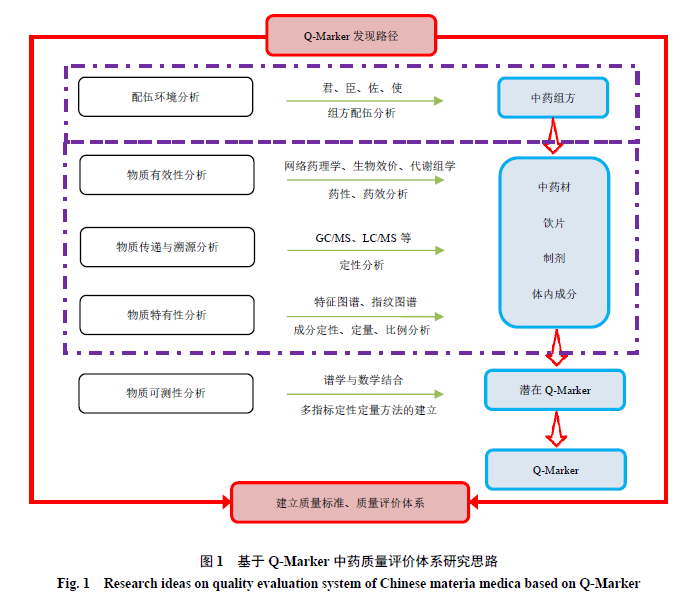
The key to the modernization and internationalization of traditional Chinese medicine is to conduct quality research on traditional Chinese medicine and establish and improve the quality evaluation system of traditional Chinese medicine,Q-MarkerThe theory embodies the characteristics and advantages of traditional Chinese medicine, and extracts the key factors of the quality of traditional Chinese medicine based on the multi-level and multi-dimensional analysis of the effectiveness of traditional Chinese medicine; base onQ-Marker"Effectiveness", "uniqueness", "testability", "traceability and transmission" and "compatibility environment"5Principle, through the means of drug property characterization, biological attribute indicators, in vivo exposure and its kinetic law to screen substances, explore the "sex-matter-The inner link of "efficiency" constructs the quality law network; Finally, a qualitative and quantitative analysis method of multi-component indicators was established to quantify the material components into quality indicators, and the effectiveness of traditional Chinese Medicine-The quality control indicators of the material base are closely related to each other, so as to formulate the quality standards of traditional Chinese medicine. developQ-MarkerResearch work, establish a framework aroundQ-MarkerCentered quality evaluation model of traditional Chinese medicine (Fig1)It is conducive to solve the problems of fragmentation and lack of systematization of the quality evaluation system of traditional Chinese medicine, and provide reference for formulating and improving the quality standard system of traditional Chinese medicine. Discussion based onQ-Marker.
Discussion on the innovation and development trend of quality evaluation system
The characteristics of traditional Chinese medicine (TCM) such as multi-component, multi-target, extensive efficacy and complex compatibility determine that its quality evaluation has certain difficulties. The current mainstream quality evaluation method refers to the qualitative and quantitative analysis of chemical drugs for quality control, which cannot give full play to the advantages and characteristics of TCM. . According to the holistic view of traditional Chinese medicine theory, the material basis of traditional Chinese medicine efficacy, compatibility environment, and the difference between Langqing traditional Chinese medicine and chemical medicine quality research are fuzzified and interpreted, providing systematic theoretical support for the construction of modern traditional Chinese medicine quality evaluation system. Carry out quality evaluation innovation, and strive to explore "sex-effect-It is a feasible idea to integrate the theory of traditional Chinese medicine property into the category of traditional Chinese medicine effectiveness, comprehensively explain the mechanism of traditional Chinese medicine efficacy by applying the philosophy of traditional Chinese medicine, and fully demonstrate the advantages of traditional Chinese medicine theory in building a modern quality evaluation system. At present, the development form of traditional Chinese medicine industry is good, but due to the deviation between traditional Chinese medicine ideology and modern medicine system, there are many problems to be solved urgently in the existing quality evaluation system of traditional Chinese medicine. More and more people in the industry pay attention to the importance of traditional Chinese Medicine theory for the quality evaluation of traditional Chinese medicine.
3.1 Process visualization quality evaluation
The process visualization technology is mainly applied to the research of the production process of traditional Chinese medicine preparations. It has gradually become the mainstream idea of quality control to detect the whole process of traditional Chinese medicine production through modern instruments and comprehensively control the production process of traditional Chinese medicine. Its advancedness lies in getting rid of the lag of inspection, tracing the source of quality abnormalities, and no longer carrying out quality control solely according to the minimum detection limit standard of traditional Chinese medicine products[39]. From the time of harvesting to entering the body, the chemical composition of traditional Chinese medicine has undergone complex and diverse changes due to various factors, and the "effective components" are constantly changing. The selection of medicinal parts of traditional Chinese medicine, the time of harvesting, the place of origin, processing method, processing, preparation process, metabolism and absorption in the body will all affect the "effective components", and affect the accuracy and specificity of the quality evaluation system of traditional Chinese medicine[40-46]The key to the quality evaluation of traditional Chinese MedicineFor the study of the material basis of traditional Chinese medicine, the improvement of the quality evaluation system of traditional Chinese medicine should be based on the indicators of "pharmacodynamic components" in the key links of the process, comprehensively consider the changes in the key links that affect the "pharmacodynamic components" of traditional Chinese medicine, and comprehensively cover the medicinal materials→ preparation → in vivo process control to realize the process visualization of the quality key attributes of "effective components". For example, using phenol-The total polysaccharide content in each operation unit of Fermented Cordyceps powder was determined by sulfuric acid method, and the partial least squares regression of total polysaccharide in the production process chain was established by combining with near-infrared spectroscopy(partial least squares regression,PLSR)Quantitative analysis model is used to analyze the quality control level of different operation units in the production process chain of Fermented Cordyceps powder. This model can realize the rapid analysis of the quality of Fermented Cordyceps powder, and provide reference for the quality evaluation mode of total polysaccharide of Fermented Cordyceps powder[47]。Q-MarkerIt is essentially a "pharmacodynamic component" with traceable characteristics, and process visualization technology is applied toQ-MarkerThe study is important forQ-Marker.
3.2 Digital quality evaluation
Under the background of big data, efficient knowledge management, knowledge acquisition and knowledge sharing are of great significance. Data information is the direct expression form of scientific and technological achievements. With the deepening of scientific research, scientific data information has increased exponentially. It is difficult to efficiently extract information, data and knowledge using traditional data mining and knowledge discovery methods. The construction of knowledge baseIt can provide discipline resource construction and personalized services in a data intensive environment, enable researchers to quickly and accurately locate knowledge needs, sort out knowledge structure, and efficiently acquire and use domain knowledge[48-49]。Data mining and knowledge integration play a guiding role in the innovation and reform of the current quality evaluation system of traditional Chinese medicine. Data mining and knowledge integration technology is also an effective tool for transforming resource management and research results into practical applications under the background of modern big data. After decades of research, the quality research of traditional Chinese medicine has a large number of literature and data information. By using knowledge base construction technology and integrating massive information resources of traditional Chinese medicine quality research, we can realize the standardized and effective integration and law exploration of traditional Chinese medicine quality data knowledge. Genuine medicinal materials are original comprehensive indicators for the quality evaluation of traditional Chinese medicine. Their literature and research data have the characteristics of many kinds and large numbers, but they are highly dispersed and the knowledge structure is not closely linked. Through data mining, we collect, screen and sort out the characteristics, microscopic and biological characteristics of medicinal materialsForm and genetic characteristics, and construct the components of genuine medicinal materials knowledge base[50]。To buildQ-MarkerTake knowledge base as an example, apply data mining technology[51]And data processing methods to complete knowledge extraction and processing, and apply Soft Computing[52]、Semantic constraints[53]Complete knowledge collation and classification, build aQ-MarkerAs the main body, traditional Chinese medicine varieties as the basic unit,Q-Marker 5The principle is rule constraint, "sex"-effect-The knowledge base based on the related knowledge of "object" constructs the domain ontology and converts it into data form, so as to realize the storage, retrieval and query of knowledge, and realize theQ-MarkerKnowledge sharing.
Build a quality evaluation system of traditional Chinese medicine based on innovative methods, introduce the nature and compatibility environment of traditional Chinese medicine, explore the correlation between the nature, efficacy and material base of traditional Chinese medicine, build a visual relationship network, and strive to realize the modern expression of ancient Chinese medicine philosophy; Using information technology to show the potential of whole process visual quality control and quality evaluation is conducive to the establishment and improvement of the quality evaluation system of the whole industrial chain of traditional Chinese medicine. Its advancement lies in relying on the theoretical basis of traditional Chinese medicine, systematically analyzing the close relationship between the material base of traditional Chinese medicine and the effectiveness of traditional Chinese medicine, refining quality indicators from an overall perspective, realizing the visibility, controllability and traceability of key quality factors, reflecting the effectiveness, safety and multi-level and multi-dimensional consideration of traditional Chinese medicine.
Copyright notice: the article is fromChinese herbal medicine 2021, 52 (09);
