
Pick To:SchisandraSchisandraIt belongs to Schisandraceae and mainly contains lignans, triterpenoids, polysaccharides, volatile oils and other chemical components. It is commonly used in the treatment of hepatitis, liver and kidney transplantation, Alzheimer's disease, insomnia and other diseases in clinic. Modern research shows that lignans in Schisandra are the main active ingredients of this genus, which have pharmacological effects such as liver protection, antitumor, antiviral, antioxidant and neuroprotection. This paper reviews the research progress of lignans in Schisandra and their pharmacological effects, so as to provide references for the subsequent research and development and comprehensive application of Schisandra.
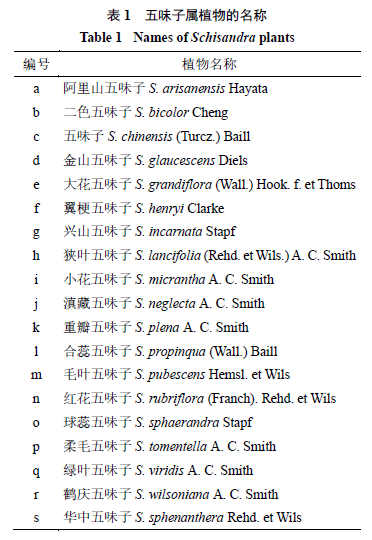
Schisandraceae(Schisandracea)Including SchisandraSchisandra MichxAnd SchisandraKadsura Kaemp f. ex Juss, distributed in Southeast Asia and Southeast North America[1]China has the most abundant resources of SchisandraceaeRich countries, of which Schisandra plants are about30Species, China19Species (table1), concentrated in the southwest and southeast regions[2]。At present, the research on Schisandra mainly focuses on Schisandra chinensis, Schisandra chinensis of central China, Schisandra chinensis of Alishan, Schisandra dichromata, Schisandra chinensis of Jinshan, Schisandra chinensis of pterygium, Schisandra chinensis of Xingshan, Schisandra chinensis of Yunnan Tibet, Schisandra chinensis of pistil, Schisandra chinensis of hairy leaves, Schisandra chinensis of safflower, Schisandra chinensis of green leaves and Schisandra chinensis of Heqing, etc. Schisandra has the functions of astringent and astringent, invigorating qi and body fluid, tonifying the kidney and calming the heart. Medical works such as Shenlong materia medica classic, compendium of Materia Medica, and dictionary of traditional Chinese medicine have included this genus, 《Chinese Pharmacopoeia》2020The quality standards of Schisandra chinensis (Schisandra chinensis) and Schisandra chinensis (Schisandra chinensis) in the[3]The plants of this genus are rich in chemical components, among which lignans are the most important class of chemical components. Biphenyl cyclooctenes are the unique compound types of Schisandra and the most potential compounds in Schisandra. They have a very broad prospect in the development of immunomodulatory and anticancer drugs. Taking schisandrone in Central China as an example, cyclolignans have a good neuroprotective effect. Monoepoxy lignans are the most prominent in anti-tumor and anti-inflammatory effects. Bicyclic oxygen lignans have a wide range of pharmacological activities, especially anti-inflammatory and antibacterial effects, and also have nitric oxide inhibitory effects.
In recent years, for the development and application of Schisandra plants, the focusIt is reflected in health care products, food and beverage, red wine and daily cosmetics. The clinical research of Schisandra Chinensis Ethanol Extract in immunosuppression has become a research hotspot. For the research of monomer compounds, biphenyl diester, a new drug for the treatment of hepatitis, was synthesized on the basis of the chemical structure of Schisandra chinensis C. not only that, Schisandra chinensis ketone isolated from Schisandra chinensis has significant antioxidant activity, especially for the study of Alzheimer's disease, a large number of pharmacological experiments have been carried out. Schisandra plants are rich in chemical components and diverse in pharmacological activities. As a famous traditional Chinese medicine in China, Schisandra is widely used clinically. At present, the research on the chemical constituents and pharmacological activities of Schisandra plants is still a hot spot in the field of Phytochemistry at home and abroad. . However, there is little systematic review and summary of lignans in Schisandra. Therefore, this paper reviews the lignans in Schisandra and their pharmacological effects19The chemical components of lignans and their carbon skeleton types in species of plants were classified and summarized in detail, and the pharmacological activities of lignans in this genus were comprehensively sorted out, aiming to provide a scientific basis for further research, development and utilization of this genus.
1 chemical composition
In recent years, scholars at home and abroad have isolated a variety of effective components from Schisandra plants and found that the fruits, stems, leaves and roots of Schisandra mainly contain lignans, triterpenoids, volatile oils, organic acids and polysaccharides. Among them, lignans are the main chemical components. At present, lignans isolated from Schisandra plants include239Species, which can be divided into biphenyl cyclooctene lignans, cyclolignans, monoepoxy lignans, simple lignans7,8-Ring opening lignans, diepoxylignans, and Neolignans. As early as1978Years,Liuetc.[4]Isolated from Schisandra chinensis5Lignansschisantherins A~E,Zhangmengting[5]It was isolated from Schisandra chinensis in Alishan, Taiwan4NeolignansarisantetralonesA~Dand7A new biphenylcyclooctene lignanarisanschinins F~L,Liuetc.[6]Isolated from Schisandra dichromata9New lignansschibitubinsA~I, in addition,Gaoetc.[7]Discovery of new lignans from Schisandra chinensis in Yunnan and Tibetneglignans A~G, mawenhui[8]Isolated from Schisandra chinensis10Lignansschisanwilsonins A~J。
1.1 Biphenylcyclooctene lignans
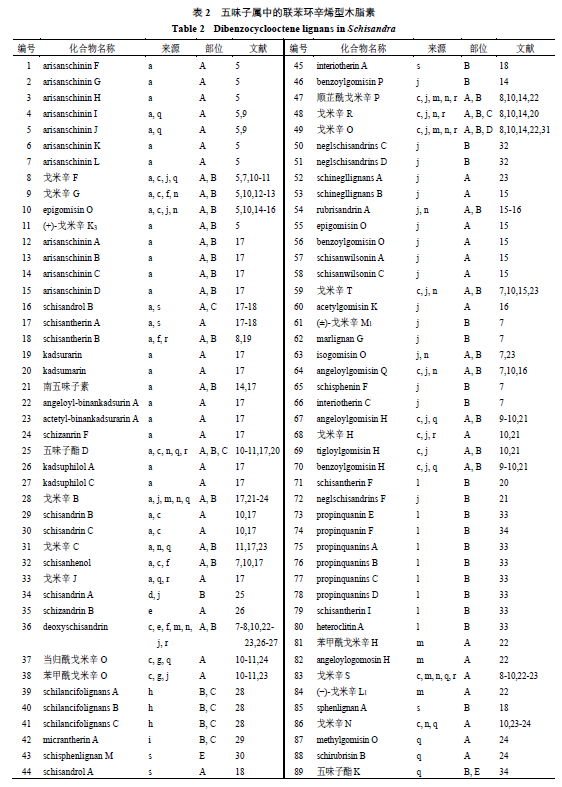
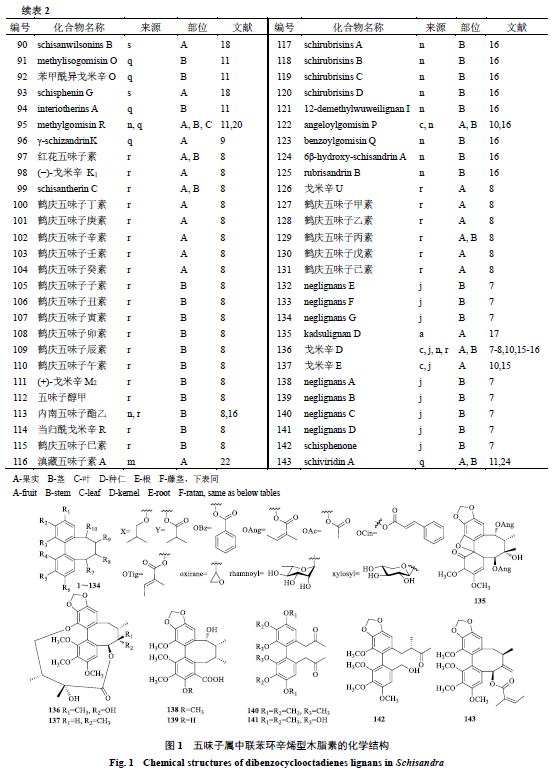
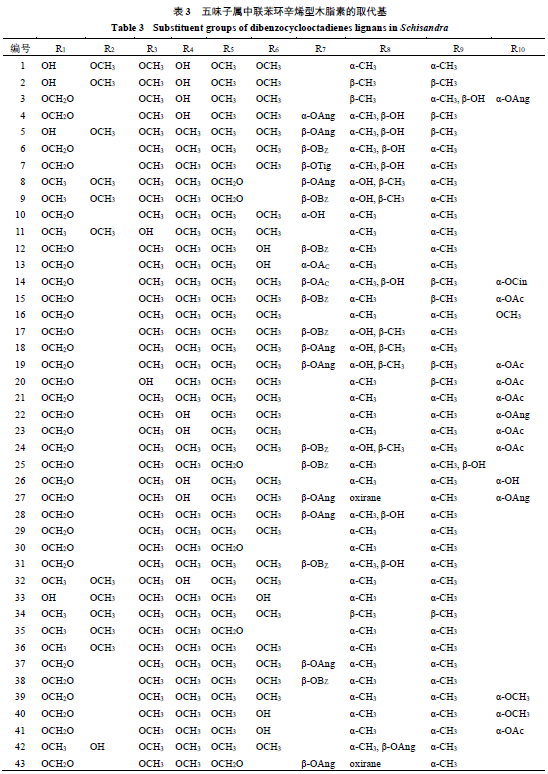
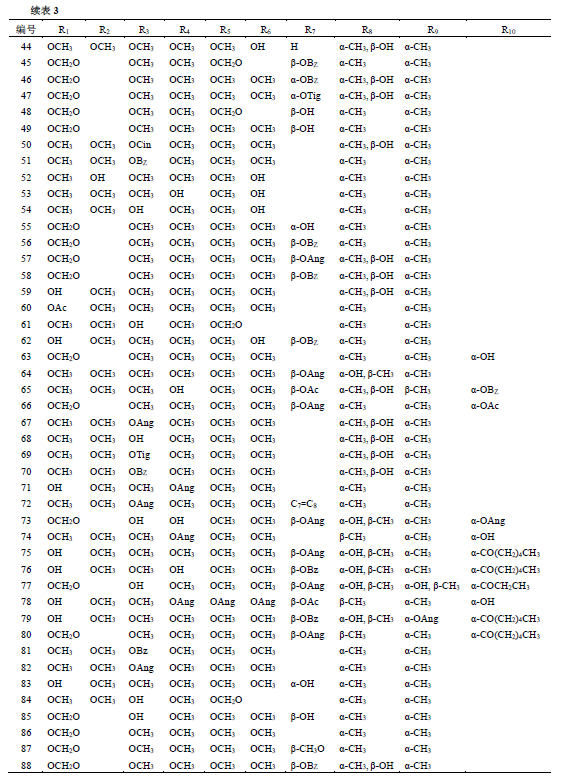
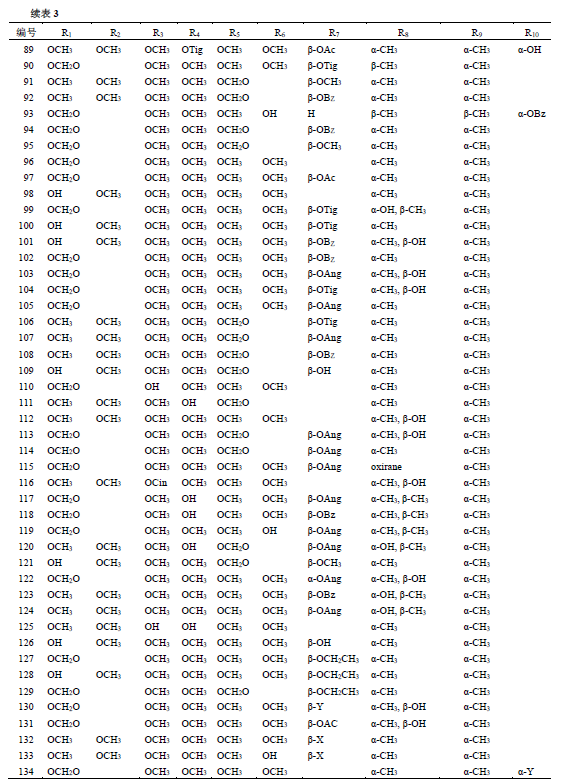
Biphenylcyclooctene lignans are the unique chemical constituents of Schisandra. The structure of this kind of lignans includes both the structure of biphenyl and the eight membered ring structure synthesized by biphenyl and side chain rings1~3、12~14The position is mainly replaced by hydroxyl, methylene dioxy or methoxy.C6The substituents at position are usually ester groups such as benzoate, acetate, angelic acid ester or CIS Zhi ester. . Through the circular dichroism spectrum235~255 nmCoton effect in(cotton effect,CE)Extrapolation,CEIs positive, biphenyl isRConfiguration,CEIs negative, biphenyl isSConfiguration; By hydrogen spectroscopy and the offerhausel nuclear effect(nuclear overhauser effect,NOE). Biphenylcyclooctene lignans from Schisandra(1~143)See table2The chemical structure is shown in Fig1And table3。hisRepresentative components includeSchisandrin a, schisandrin B, schisandrin a, schisandrin B,,Gomisin F,Gomisin g,Gomisin h,Gomisin n,Angelioylgomicin h,Angelioyl gomisin o, benzoyl gomisin o, etc.
1.2 Cyclolignan
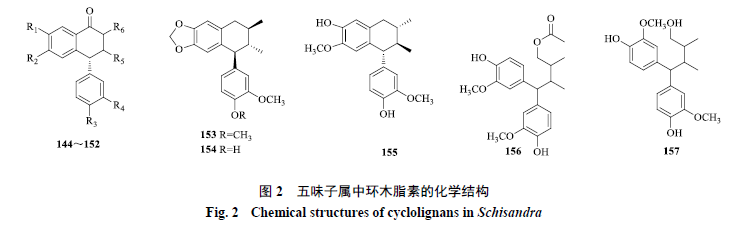
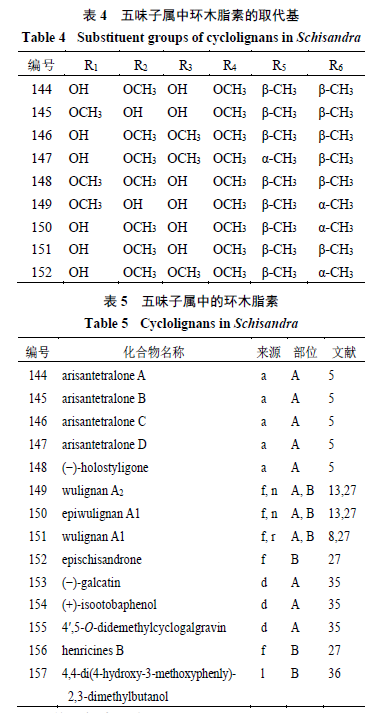
Cyclolignans are produced by1Of the benzene ring in phenylpropanoid units6Bit and another1Phenprocoumon7Positional cyclization formation. In the infrared spectrum, the common characteristic absorption group of this kind of lignans is hydroxyl group(3600~3100 cm−1), methylenedioxy(940~920 cm−1)And carbonyl(1700~1660cm−1). Cyclolignans in Schisandra plants.The research of the effect of cyclolignans on the quality of Schisandra plants in China and its application in the industry of food science and technology in China.The research of the production of cyclolignans in Schisandra plants in China and its application(144~157)OfThe chemical structure is shown in Fig2And table4See table for compound names, plant sources and parts5。
1.3 Monoepoxy lignans..the main content of the paper is as follows:the content of the product is as follows:the content of the product is as follows:the content of the product is: 1.1.2.2.2.2.2.2
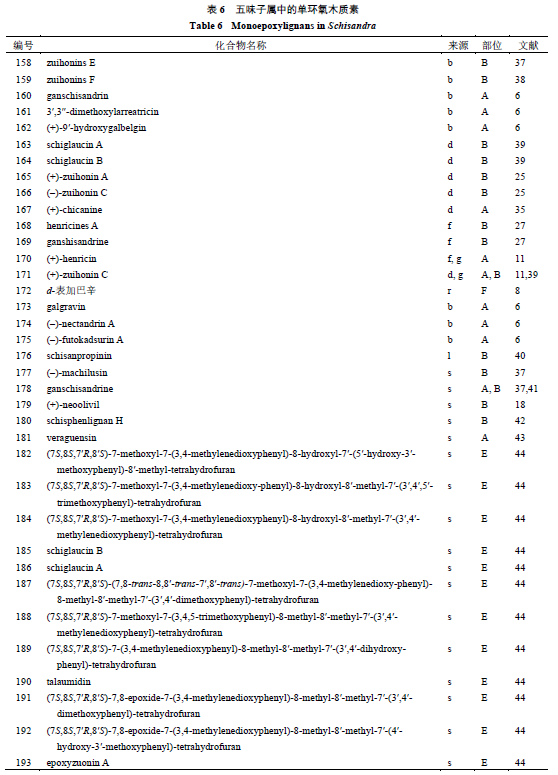
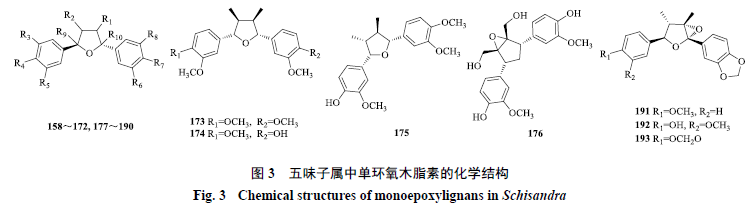
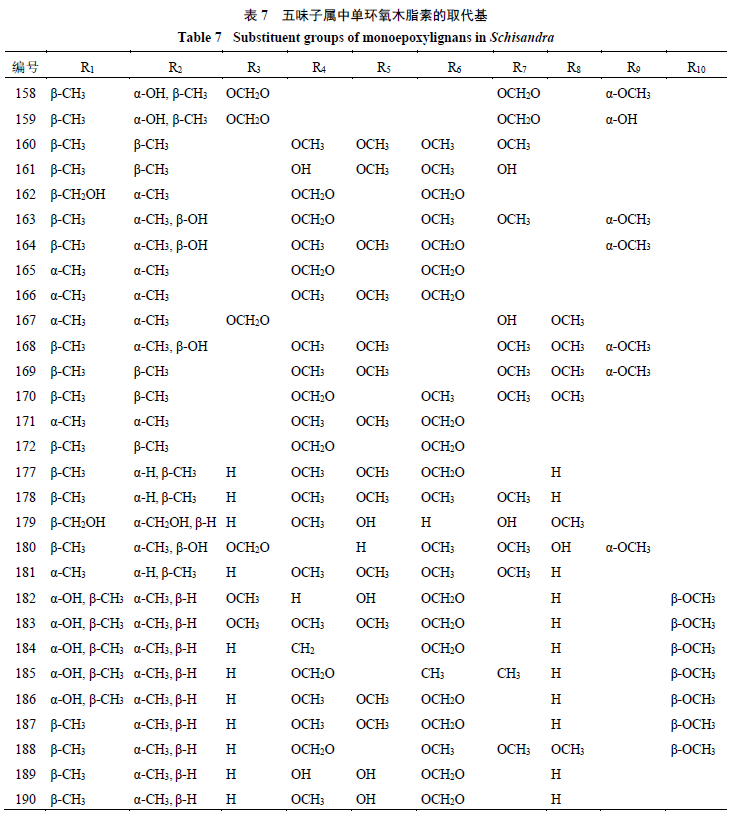
The structure of monoepoxy lignin is characterized by the presence of tetrahydrofuran structure on the basis of simple lignin, such as7-O-7′、9-O-9′or7-O-9′And other structural types. The main components in Schisandra are7-O-7′Type A is the most common type. This type of structure often has a symmetrical structure, which can be seen in the hydrogen spectrum2individualdThe methyl signals of peaks overlapped. stayδ 1.78Left and right2individualmHydrogen signals of peaks. Monoepoxidized lignans from Schisandra plants.The study of the chemical composition of the plant and its application in the field of biological engineering and biological engineering of Schisandra plants in China.The research of monoepoxidized lignans in Schisandra plants in China and its application in the field(158~193)See table6The chemical structure is shown in Fig3And table7。Its representative components are Larch resin, (+) - Larch resin,D-megabacin, xiangwuzhisu, dehydrated ring opening isolaricin, etcEt al.
1.4 Simple lignans
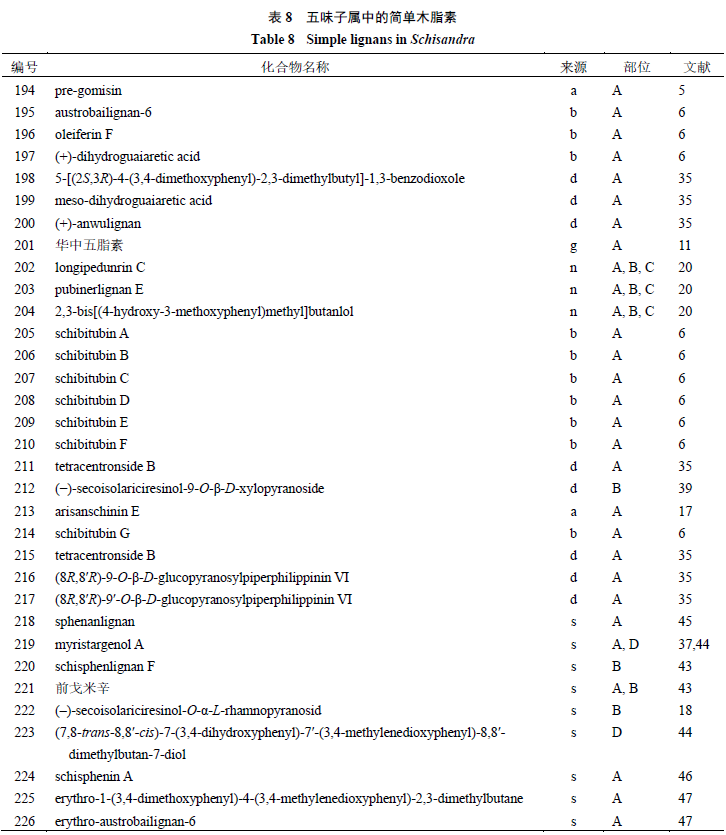
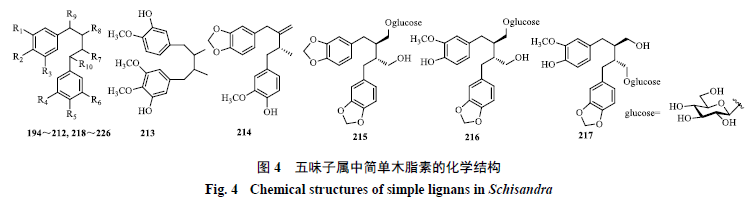
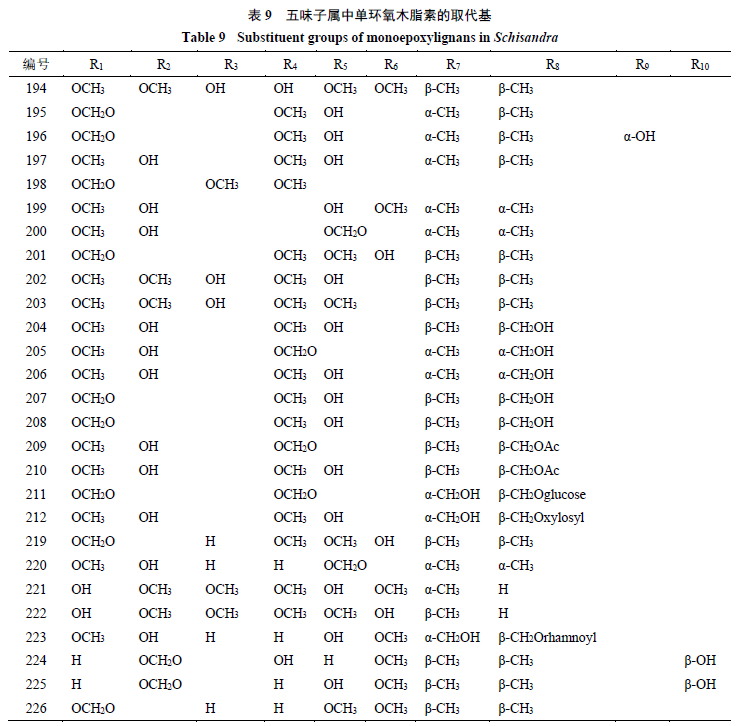
Simple lignans are made from2Molecular phenylpropanoid was only detected byβCarbon atom at position(C8-C8′)This kind of lignans can be usedEI-MSAccording to the determination, most lignans can obtain molecular ion peaks, and lignans can undergo benzyl cleavage due to benzyl groups. These compounds are also the biogenic precursors of some other types of lignans. Simple lignans from Schisandra(194~226)See table8The chemical structure is shown in Fig4And table9Its representative compounds include anwuzhisu, etc.
1.5 7,8-Ring opening lignan
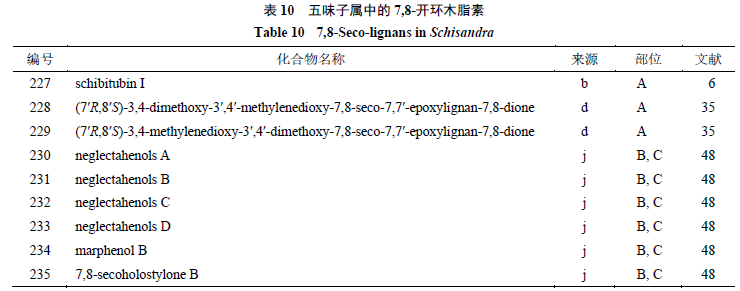
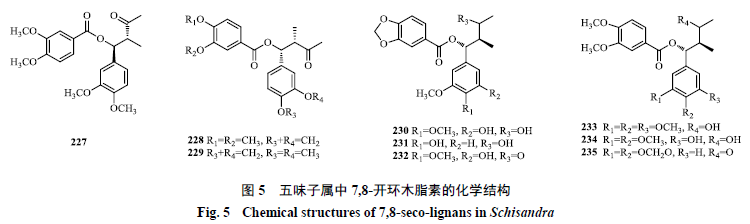
7,8-The backbone of ring opening lignans is aryltetrahydrofuran lignansC7-C8Oxidative cleavage of bonds. Co isolated from fruits, stems and leaves of Schisandra9Compounds. In Schisandra7,8-Ring opening lignan(227~235)See table10The chemical structure is shown in Fig5Its representative component is ring opening isolaricin (ring opening isolarix resin phenol).
1.6 Dicyclooxylignan
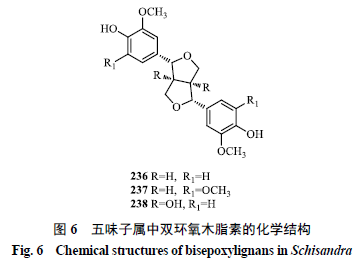
Dicyclooxylignan is a kind of lignan produced by2The molecular phenylpropanoids are interconnected to form lignans with double parallel tetrahydrofuran ring structure, and most of them have4Optical isomers of chiral carbons, on the NMR carbon spectrumC7andC7′The chemical shift of position can reach85.0Above, due to the symmetry of its structure, the hydrogen spectrum and carbon spectrum often have overlapping signals.(+)-pinoresinol(pinoresinol 236)、(+)-syringaresinol(Syringin phenol 237)Andprinsepiol(238)All from the stems of Schisandra chinensis[25,39]The chemical structure is shown in Fig6Its representative compounds are alsoPinoresinol dimethyl ether,Pinoresinol diglucoside, acanthopanax senticosus glycoside E and so on.
1.7 Neolignans
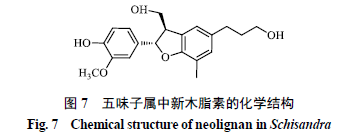
NeolignansIs caused by2Phenprocoumon is formed by side chain, benzene ring or oxygen connection, and is formed inC8andC8′There is no chemical bond between them.C9When the position is hydroxymethyl, the carbon spectrumδ 89.0、55.5、65.0It is a benzofuran type neolignanC7、C8、C9. In addition, Neolignans also include2Connected by oxygen ether bond in the form of oxygen bondC6-C3Monomers, therefore also known as oxyneolignans.vladinol F(239)It can be isolated from the stems of Schisandra chinensis and Schisandra chinensis[30,39]The chemical structure is shown in Fig7。
2 pharmacological action
2.1 Liver protection
Chenetc.[49]Research findingsSchisandra arisanensis in(+)-GomisinK3(11)It has significant antifibrotic activity. Wangjuping[50]According to the liver injury experiment caused by acute intrahepatic cholestasis in rats, it was found thatdeoxyschisandrin(36)Can reduce alanine aminotransferase(alanineaminotransferase,ALT), glutamate aminotransferase(aspartate aminotransferase,AST)(alkaline phosphatase,ALP)(total bilirubin,TBIL)Levels, elevated in the liverNa+, K+-ATPLiver protective effect due to enzyme activity. In addition, the lignans in the extract of Schisandra chinensis residue had a significant effect onCCl4It has protective effect on acute liver injury in rats[51]The liver protective effect of lignans from Schisandra chinensis is the most widely studied,Gaoetc.[52]Discovery compounds(+)-anwulignan(200)ASTandALTActivity, the mechanism may be related to the activationp38Mitogen activated eggThe antioxidant capacity of white kinase pathway is related to increasing the viability of damaged cells; Monomeric compoundschisandrol B(16)It has a significant hepatoprotective effect. Researchers found that it can reduce acetaminophen induced hepatotoxicity by activating nuclear factorE2Correlation factor2(nuclear factor NF-E2-related factor 2,Nrf2)/Antioxidant response element(anti-oxidant response element,ARE)Pathways and regulationNrf2Target genes, thereby inducing detoxification[53]. in addition,schisandrol BIt also has the function of promoting liver regeneration in mice[54]。
2.2 Antitumor
Zhangmengting[5]The study found that the monomeric compounds in Schisandra chinensisarisanschinin F(1)For human medulloblastomaDaoyCell, colon cancerWiDrCell, human laryngeal epidermoid carcinomaHEp-2Cell, human breast cancerMCF-7The cells had obvious cytotoxic activity, and the half effective amount was respectively.The results showed that the cell proliferation rate of the two groups was 0.5%, 0.5%, 0.5%, 0.5%, 0.5%, 0.5%, 0.5%, 0.5%, 0.56.23、6.08、4.12、4.09 μg/mL. Neolignans isolated from Schisandra dichromatazuihonins E~F(158~159)Can inhibit human liver cancerHepG2Cell, human lung cancerA549Cells andMCF-7Cell growth[39]。Chenetc.[21]findneglschisandrins F(72)RightA549At the same time, the monomer compound has a good inhibitory effect on human colon cancerHCT-8The cells exhibited moderate cytotoxicity.Gaoetc.[55]Compounds were isolated from Schisandra chinensisschisantherin F(71), studies have shown thatschisantherin FBy inhibiting caspases-3(cystein-asparate protease-3,Caspase-3)andCaspase-9Activity of, downregulatedBLymphoblastoma-2(B-cell lymphoma-2,Bcl-2)Bcl-2correlationXProtein(B-cell lymphoma-2/Bcl-2 associated X protein,Bax)To induce human melanomaA375Apoptosis of cells; Breast cancer is a multiple disease nowadays. For the study of this disease, Schisandra chinensis has significant pharmacological activity. Studies have reported that its anti-tumor active ingredients includeangelylgomisin H(67)H(68)[56-57]。Yangetc.[58]Discovery compounds(+)-GomisinM2(111)BCSCsProliferation; J(33)RightMCF-7Cell, breast cancerMDA-MB-23Cells and others11All kinds of cancer cells have significant cytotoxic activity[59]. the findings for triple negative breast cancerschisandrinA(34)May be a potential candidate for its treatment[60]。
2.3 antiviral
Modern pharmacological studies have shown that Schisandra plants have significant antiviral effects. The research group of sun Handong has carried out extensive research on Schisandra plants and found that a variety of plants in Schisandra have this pharmacological activity.Chenetc.[61]Discovery of the lignan gomisin in Schisandra chinensisJ, gomisinM2、(±)-GomisinM1(61)With anti human immunodeficiency virus(human immunodeficiency virus,HIV)Activity,(±)-GomisinM1Showed the most effective anti -HIVActivity.Xueetc.[62]Isolated from the fruit of Schisandra chinensismethylgomisinO(87)It has strong anti hepatitis B virus(hepatitis B virus,HBV)Viral activity, and its half inhibitory concentration was5.49 μg/mLGomisin isolated from Schisandra chinensis in AlishanB(28)G(9)In anti -HBsAgandHBeAgShowed moderate activity in the test[63]。Maetc.[64]The anti -HBVLignan active ingredientschisanwilsonins A~G, whereschisanwilsonins CresistHBVThe activity is the most significant.
The lignans in Schisandra spp. are not only effective for humanHIV、HBVIn addition to the effects of other viruses, there are also some research reports on plant viruses.Wangetc.[65]The study found that the contents ofschisanhenol(32)It can prevent and control tobacco mosaic virus, and has antiviral effectbe better thanNingnanmycin. In addition, lignans from Schisandra chinensis in Yunnan and Tibet were also foundneglectahenols E~FAlso has anti TMV activity[66]。
2.4 antioxidant
The researcher isolated from the ethyl acetate part of Schisandra chinensisarisanschinins EWith obvious1,1-Diphenyl-2-Trinitrophenylhydrazine(1,1-diphenyl-2-picrylhydrazylradical,DPPH)Free radical scavenging activity[67]。Wangetc.[68]By studying the antioxidant activity of lignans in Schisandra chinensis and Schisandra chinensis from different habitats, it was found that the main antioxidant active components wereschisanhenolandschisandrin B(29). at the same timeJiangetc.[44]The chemical constituents and antioxidant activity of Schisandra chinensis root were isolated, and the lignans isolated had different degrees of scavengingDPPHFree radical capacity, in which compounds190Antioxidant activity and vitaminsCIt has significant antioxidant hemolysis effect on the life span of human red blood cells. In addition, the total lignans of Schisandra chinensis also have a good ability to scavenge superoxide anion radicals[69]。
2.5 nerveprotect
Isolated from Schisandra dichromataschiglaucin A(163)、(+)-chicanine(167)、d-Epigalasin(172)、galgravin(173)In amyloidβProtein fragment25-35(Aβ25-35)Induced human neuroblastomaSH-SY5YShowed good neuroprotective activity in cell injury models[6]In addition, the isolated from the stem of Schisandra chinensis2A new tetrahydrofuran lignanschiglaucin Aandschiglaucin B(164)RightSH-SY5YCell injury also has a significant neuroprotective effect[35,39]. by ratMorrisWater maze test, Yu Fang et al[70]It was found that Huazhong schisandrone affected the hippocampal region of rats bynuclear factor-κBSignal transduction pathway to play a protective role in the pathogenesis of Alzheimer's disease. In addition, studies have found that improving the activity of antioxidant system and promoting the scavenging of oxygen free radicals in the brain of rats may be a new mechanism of action of schisandrone in the treatment of Alzheimer's disease model rats[71]。
3 Conclusion and Prospect
Schisandra resources are abundant in China, concentrated in the southwest and southeast regions. With the continuous in-depth study of the plant components of this genus, its modern pharmacological research has also made great progress, especially its main active component lignans, which have a wide range of pharmacological activities, and have outstanding effects in liver protection, antitumor, antioxidant, and neuroprotection. At present, there is a more detailed review on the research of Schisandra chinensis, but there are relatively few reports on the chemical constituents and pharmacological effects of other plants in this genus. .
It is worth noting that for the research and development of monomeric compounds, schisandrone, schisandrin a, schisandrin B, schisandrin C and schisandrin phenol are the most widely studied. Schisandrin C has a good therapeutic effect on hepatitis. Based on this structure, the first new drug biphenyl diester for the treatment of hepatitis in China has been developed,2004In the treatment of hepatitisIThe listing of bicyclol, a new drug of Schisandra chinensis, further proves the unique liver protective effect of Schisandra chinensis. Therefore, it is still of great significance to find new lead compounds with the value of developing new drugs from the natural products of Schisandra. In addition, lignans with outstanding antioxidant effect are expected to become new antioxidants, laying the foundation for the research and development of drugs for cardiovascular and cerebrovascular diseases. For the ethanol extract with outstanding immunosuppressive effect in organ transplantation, its pharmacological mechanism still needs to be further studied. Schisandra plants can enhance immunity, improve memory and sleep, and can be used to develop a wider range of health products. Red wine, fructose drinks and skin care products also need further development and promotion. In terms of clinical application research, it is reported that Schisandra chinensis leaves have a certain therapeutic effect on bone injury, which should be paid attention to.
Conflict of interest
References (omitted)
Come ; Hao, Zhang Huawei, Deng Chen, song Xiaomei, Zhang Dongdong, Wang Wei. Research progress on lignans from Schisandra and their pharmacological effects [J] . Chinese herbal medicine, 2022, 53 (6): 1903-1918